
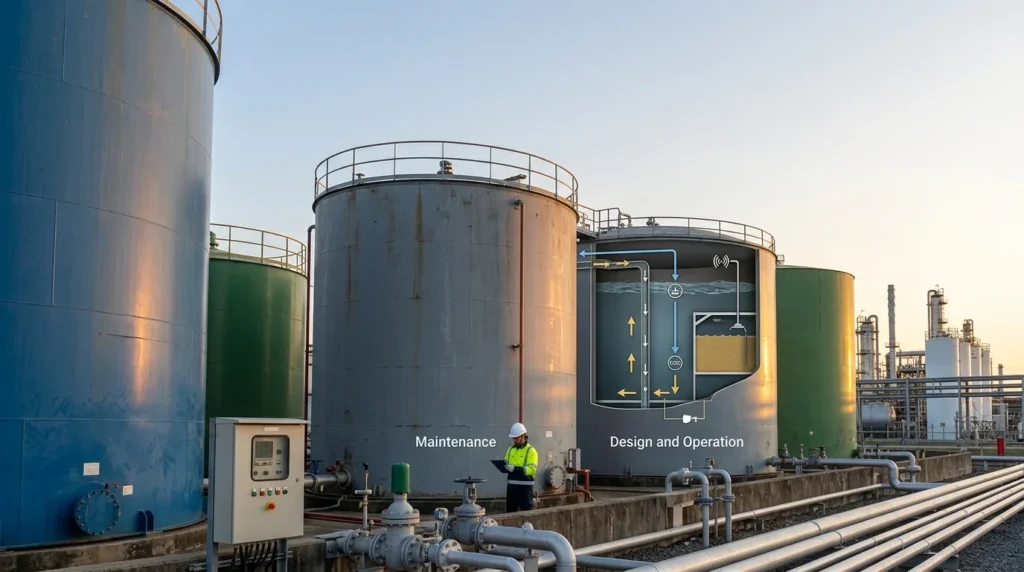

Overview of Industrial Storage Tanks
Table of Contents
Industrial storage tanks are large, engineered vessels designed to hold liquids, liquefied gases, or slurries in bulk. Unlike process vessels that are part of a continuous chemical reaction, storage tanks serve as inventory buffers—they hold raw materials, intermediates, or finished products until they are needed.
These tanks vary enormously in size, from a few thousand liters to more than 100,000 cubic meters. They can be installed aboveground, underground, or mounded, and they may operate at atmospheric pressure, under low pressure, or at high pressure depending on the product being stored.
The choice of tank type, material, and design code depends on several factors:
-
Product properties: Vapor pressure, corrosivity, toxicity, flammability, and temperature sensitivity.
-
Storage capacity: Required volume and available footprint.
-
Site conditions: Soil bearing capacity, seismic zone, wind loads, and climate.
-
Regulatory requirements: Local fire codes, environmental regulations, and industry standards.
The most widely used design standards for industrial storage tanks are published by the American Petroleum Institute (API) and the American Society of Mechanical Engineers (ASME) . API 650 governs welded steel tanks for oil storage at atmospheric pressure, while API 620 covers low-pressure tanks. For higher pressures, ASME Section VIII applies.
Key Features of Modern Industrial Storage Tanks
Modern storage tanks are far more than simple steel cylinders. They incorporate a range of features that ensure safety, environmental protection, and operational efficiency.
Containment and Structural Integrity
-
Primary containment: The tank shell, bottom, and roof form the primary barrier against leakage.
-
Secondary containment: Dikes, berms, or double-walled construction provide a second layer of protection if the primary tank fails.
-
Leak detection: Interstitial monitoring systems, especially in double-bottom tanks, detect leaks before they reach the environment.
Pressure and Vacuum Protection
-
Pressure/vacuum relief valves: These devices prevent overpressure or vacuum collapse during filling, emptying, or thermal changes.
-
Emergency venting: Frangible roof joints or emergency relief valves protect tanks exposed to fire by relieving internal pressure before the shell ruptures.
-
Venting per API 2000: Normal and emergency venting capacities are calculated according to API Standard 2000, which covers both nonrefrigerated and refrigerated tanks.
Level and Inventory Management
-
Automatic tank gauging (ATG): Radar, servo, or float-based systems provide continuous level measurement.
-
Overfill prevention: High-level alarms and automatic shutoff systems prevent spills during filling operations.
-
Inventory reconciliation: Temperature-compensated volume calculations ensure accurate stock accounting.
Corrosion Protection
-
Internal linings: Epoxy, polyurethane, or rubber linings protect the steel from aggressive chemicals.
-
External coatings: Polyurethane, acrylic, or epoxy coatings resist atmospheric corrosion and UV degradation.
-
Cathodic protection: Sacrificial anodes or impressed current systems protect the soil-side of tank bottoms from corrosion.
-
Material selection: Carbon steel, stainless steel (304, 316, 316L), fiberglass-reinforced plastic (FRP), and high-alloy materials are chosen based on the stored product.
Fire Protection
-
Foam systems: Low-expansion, medium-expansion, or high-expansion foam is used to extinguish flammable liquid fires.
-
Water spray or deluge systems: These cool the tank shell to prevent rupture when exposed to fire.
-
Fire-resistant tank design: NFPA 30 defines requirements for fire-resistant tanks, which are designed to prevent release of liquid in a fire exposure scenario.
Environmental Controls
-
Vapor recovery: Systems capture displaced vapors during filling to prevent emissions.
-
Floating roofs: External and internal floating roofs reduce evaporation losses by covering the liquid surface.
-
Secondary containment dikes: These structures contain spills and leaks, preventing soil and groundwater contamination.
What’s New in Latest Tank Design and Technology (2026)
The storage tank industry continues to evolve. Recent developments focus on safety, environmental performance, and digitalization.
Updated Standards and Codes
-
API Std 653, 5th Edition (with Addendum 4, July 2025): This update to the tank inspection, repair, alteration, and reconstruction standard introduces clearer guidance on hot tap nozzles, revised requirements for door sheets used for temporary access, and improved settlement analysis methods.
-
API Std 650 (2025): The latest edition of the welded tank standard incorporates updated material specifications and design provisions.
-
NFPA 30 (2024 Edition): The Flammable and Combustible Liquids Code includes new annexes on emergency control systems and tank spacing evaluation.
Digitalization and Smart Tank Monitoring
-
IoT-enabled sensors: Wireless level, temperature, and pressure sensors provide real-time data to cloud platforms.
-
Predictive maintenance: Machine learning algorithms analyze sensor data to predict corrosion rates, seal wear, and equipment failures before they occur.
-
Digital twins: Virtual replicas of physical tanks simulate operating scenarios and optimize maintenance schedules.
Advanced Corrosion Protection
-
Nanocomposite coatings: New epoxy/Ni-Al ferrite nanocomposite coatings show improved anticorrosion performance for carbon steel tanks storing oil.
-
Self-healing coatings: Research into microcapsule-based coatings that release corrosion inhibitors when damaged is progressing toward commercial application.
Floating Roof Enhancements
-
Improved rim seal systems: Better sealing materials and designs reduce vapor emissions from floating roof tanks.
-
Full-contact floating roofs: These roofs provide better evaporation control and are designed to remain buoyant under combined process, weather, and product loads.
System Requirements: Key Design Parameters
Designing an industrial storage tank requires careful consideration of multiple parameters. The following table summarizes the key design inputs and typical values.
| Parameter | Typical Range / Specification | Reference Standard |
|---|---|---|
| Design internal pressure | Atmospheric to 2.5 psig (API 650); up to 15 psig (API 620) | API 650, API 620 |
| Design temperature | −325°F to 250°F (cryogenic to elevated) | API 620, ASME |
| Shell material | Carbon steel (ASTM A36, A283), stainless steel (304/316), FRP | API 650, ASME |
| Minimum shell thickness | 6 mm for diameters 6–36 m | API 650 |
| Bottom plate thickness | 6 mm minimum (9 mm typical) | API 650 |
| Roof type | Cone, dome, floating (external or internal) | API 650 |
| Foundation | Ring wall, mat, or pile foundation | API 650, geotechnical report |
| Wind design | Per ASCE 7 or local code | API 650 |
| Seismic design | Per API 650 Appendix E or ASCE 7 | API 650 |
| Venting capacity | Per API 2000 | API 2000 |
| Secondary containment | 110% of largest tank volume | EPA SPCC, NFPA 30 |
For tanks operating at internal pressures above 15 psig, ASME Section VIII Division 1 or Division 2 is used. Spherical or cigar-shaped tanks are common for high-pressure storage of liquefied petroleum gas (LPG), ammonia, and other volatile products.
Installation Guide: Step-by-Step Tank Construction
Installing an industrial storage tank is a major engineering project. The process involves careful planning, fabrication, foundation work, erection, and commissioning.
Step 1: Site Selection and Preparation
-
Geotechnical investigation: Soil borings determine bearing capacity, settlement potential, and groundwater conditions.
-
Site grading: The area is leveled and compacted to provide a stable working surface.
-
Access roads: Adequate access for cranes, trucks, and maintenance vehicles must be provided.
Step 2: Foundation Construction
-
Ring wall foundation: Most large atmospheric tanks are supported on a reinforced concrete ring wall that distributes the tank load to the soil.
-
Tank pad: A sand or gravel pad is placed inside the ring wall to support the tank bottom.
-
Anchor bolts: These are embedded in the concrete to secure the tank shell against wind and seismic uplift.
Step 3: Tank Fabrication and Erection
-
Shop fabrication: Shell plates, bottom plates, and roof plates are cut, rolled, and welded in a fabrication shop.
-
Site erection: The tank is assembled on site using one of several methods:
-
Jacking method: The shell is assembled at ground level and progressively jacked upward.
-
Crane method: Pre-assembled shell sections are lifted into place by cranes.
-
Conventional method: Plates are assembled course by course from the bottom up.
-
Step 4: Welding and Inspection
-
Welding procedures: Qualified welding procedures and certified welders are required.
-
Non-destructive examination (NDE): Radiographic, ultrasonic, magnetic particle, or dye penetrant testing is performed on critical welds.
-
Hydrostatic testing: The completed tank is filled with water to test for leaks and to settle the foundation.
Step 5: Auxiliary Systems Installation
-
Piping and valves: Inlet, outlet, drain, and vent connections are installed.
-
Instrumentation: Level gauges, temperature sensors, pressure transmitters, and high-level alarms are installed and calibrated.
-
Fire protection: Foam systems, water spray systems, and fire detection equipment are installed.
-
Cathodic protection: Anode beds or impressed current systems are installed for soil-side corrosion protection.
Step 6: Commissioning
-
Pre-startup safety review: A comprehensive review ensures all systems are ready for operation.
-
Operational testing: Systems are tested under normal and emergency conditions.
-
Documentation: As-built drawings, operating procedures, and maintenance manuals are finalized.
How to Use the Software: Operating Industrial Storage Tanks Safely
Operating storage tanks safely requires adherence to established procedures, continuous monitoring, and a strong safety culture.
Daily Operations
-
Level monitoring: Check tank levels regularly using gauging systems or manual gauging.
-
Temperature checks: Monitor product temperature, especially for heated or refrigerated tanks.
-
Visual inspection: Look for leaks, corrosion, discoloration, or unusual conditions around the tank.
-
Vent check: Ensure pressure/vacuum relief valves and vents are unobstructed and functioning.
Filling and Emptying Procedures
-
Pre-transfer checks: Verify tank capacity, valve alignment, and grounding/bonding connections.
-
Overfill prevention: Use high-level alarms and automatic shutoff systems. Never rely solely on manual gauging.
-
Vapor control: Use vapor recovery systems or ensure proper venting to prevent emissions.
-
Flow rate control: Avoid rapid filling or emptying that could generate static electricity or cause pressure surges.
Emergency Procedures
-
Spill response: Have a written spill response plan and ensure spill kits are available.
-
Fire response: Know the location of fire extinguishers, foam systems, and emergency shutdown switches.
-
Evacuation: Establish clear evacuation routes and assembly points.
-
Notification: Know who to notify in case of a spill, fire, or equipment failure.
Permit Systems
No work should be performed on or near a storage tank without a formal work permit. Hot work (welding, cutting, grinding) requires a hot work permit. Confined space entry requires a confined space permit with atmospheric testing.
Best Use Cases for Industrial Storage Tanks
Industrial storage tanks serve a wide range of applications across multiple industries. The table below summarizes the most common use cases and the typical tank types used.
| Industry | Typical Products Stored | Recommended Tank Type |
|---|---|---|
| Oil & Gas | Crude oil, gasoline, diesel, jet fuel | External floating roof (API 650), internal floating roof |
| Petrochemical | Solvents, alcohols, glycols | Fixed roof with internal lining, floating roof |
| Chemical | Acids, bases, specialty chemicals | Stainless steel, FRP, lined carbon steel |
| Water Treatment | Potable water, wastewater, brine | Concrete, glass-fused-to-steel, FRP |
| Food & Beverage | Edible oils, syrups, juices | Stainless steel 304/316, sanitary design |
| Cryogenic | LNG, liquid oxygen, liquid nitrogen | Double-walled cryogenic tanks (API 620) |
| Agriculture | Fertilizers, liquid feed | Carbon steel with epoxy lining, FRP |
| Power Generation | Fuel oil, demineralized water | Fixed roof, floating roof |
| Fire Protection | Foam concentrate, water | Carbon steel with internal lining |
Case Study: Floating Roof Tank for Crude Oil Storage
A typical crude oil storage tank at a refinery uses an external floating roof to minimize vapor losses. The roof floats on the liquid surface, rising and falling with the liquid level. The rim seal system—attached to the roof perimeter—contacts the tank wall to prevent vapor escape. This design reduces evaporation losses by up to 95% compared to a fixed roof tank.
Case Study: Cryogenic Tank for LNG Storage
LNG is stored at −162°C in a double-walled cryogenic tank. The inner tank holds the liquid, while the outer tank contains insulation (perlite or foam) and provides secondary containment. The tank is designed to withstand the low temperatures, thermal cycling, and potential leakage of cryogenic liquid.
Advantages and Limitations of Industrial Storage Tanks
Advantages
-
Economical bulk storage: Storage tanks provide the most cost-effective method for storing large volumes of liquids and gases.
-
Safety: Modern design standards and safety systems minimize the risk of spills, fires, and explosions.
-
Environmental protection: Secondary containment, vapor recovery, and leak detection systems prevent environmental contamination.
-
Operational flexibility: Tanks can be designed for a wide range of products, temperatures, and pressures.
-
Scalability: Tanks can be built in virtually any size, from small shop-fabricated units to field-erected giants exceeding 100,000 m³.
Limitations
-
Land requirements: Large tanks require significant land area, especially when secondary containment is required.
-
Capital cost: Field-erected tanks involve substantial capital investment for foundations, fabrication, and auxiliary systems.
-
Maintenance requirements: Regular inspection, cleaning, and repair are essential to maintain integrity and extend service life.
-
Environmental risks: Despite safeguards, spills and leaks can occur, especially in aging tanks.
-
Regulatory burden: Compliance with multiple codes and standards (API, NFPA, EPA, OSHA) requires dedicated resources.
Alternatives to Industrial Storage Tanks
While storage tanks are the most common solution for bulk liquid storage, alternatives exist for specific applications.
| Alternative | Best For | Key Differences |
|---|---|---|
| Underground storage | Fuel at retail stations, hazardous liquids | Lower fire risk, but harder to inspect and repair |
| Mounded storage | LPG, flammable liquids | Tank is covered with earth, providing blast protection |
| Pipeline storage (line pack) | Natural gas, refined products | Uses pipeline itself as storage; limited capacity |
| Flexible bladder tanks | Temporary storage, remote sites | Portable, low-cost; limited capacity and lifespan |
| Concrete tanks | Water, wastewater | Durable, low maintenance; expensive for large volumes |
| Salt caverns | Natural gas, hydrogen | Very large capacity; geographically limited |
| Aboveground vs. underground | — | Aboveground is easier to inspect; underground saves surface space |
Comparison: API 650 vs. API 620 vs. ASME
| Feature | API 650 | API 620 | ASME Section VIII |
|---|---|---|---|
| Pressure range | Atmospheric to 2.5 psig | Up to 15 psig | Above 15 psig |
| Temperature range | Ambient | −325°F to 250°F | Wide range |
| Typical use | Oil storage | Low-pressure, cryogenic | High-pressure gases |
| Roof type | Cone, dome, floating | Dome, conical | Spherical, cylindrical |
| Design philosophy | Minimum requirements for oil storage | Low-pressure storage | Pressure vessel design |
Frequently Asked Questions (FAQ)
Q1: What is the difference between API 650 and API 620 storage tanks?
API 650 covers atmospheric storage tanks with internal pressures up to 2.5 psig. API 620 is for low-pressure tanks with internal pressures up to 15 psig and can handle much lower temperatures, down to −325°F, making it suitable for cryogenic storage.
Q2: How often should industrial storage tanks be inspected?
Routine visual inspections are recommended monthly or quarterly. External inspections are typically performed every 3–5 years. Internal inspections are required at intervals not exceeding 20 years for initial inspection, or 30 years if a release prevention barrier is in place, according to API Std 653.
Q3: What is the purpose of a floating roof in a storage tank?
A floating roof rests on the liquid surface and rises and falls with the liquid level. It minimizes the vapor space above the liquid, reducing evaporation losses and preventing the accumulation of flammable vapors.
Q4: What are the most common materials used for storage tank construction?
Carbon steel is the most common material due to its low cost and high strength. Stainless steel is used for corrosive products. Fiberglass-reinforced plastic (FRP) is used for highly corrosive chemicals. Other materials include aluminum, concrete, and high-alloy steels.
Q5: How does cathodic protection work on storage tanks?
Cathodic protection uses sacrificial anodes or an impressed current system to make the tank bottom the cathode of an electrochemical cell. This prevents the steel from corroding by shifting its potential to a more negative value.
Q6: What is secondary containment and why is it required?
Secondary containment is a system—such as a dike, berm, or double wall—that contains spills or leaks from the primary tank. It is required by environmental regulations (e.g., EPA SPCC) to prevent contamination of soil and groundwater.
Q7: What is the maximum spacing between storage tanks?
NFPA 30 specifies minimum separation distances between tanks based on the properties of the stored liquid and the tank design. These distances are intended to prevent fire spread from one tank to another. Typical minimum spacing is 3 feet (0.9 m), but larger distances may be required for flammable liquids.
Q8: Can storage tanks be repaired while in service?
Some repairs, such as hot tapping or external welding, can be performed while the tank is in service under strictly controlled conditions. However, most internal repairs require the tank to be emptied, cleaned, and gas-freed. API Std 653 provides detailed requirements for in-service and out-of-service repairs.
Final Thoughts
Industrial storage tanks are critical infrastructure that supports modern industry. Their design, operation, and maintenance require a multidisciplinary approach that combines structural engineering, materials science, corrosion control, fire protection, and environmental management.
Whether you are specifying a new tank, planning a maintenance program, or responding to a regulatory inspection, the principles and standards outlined in this guide provide a solid foundation. Always consult the latest editions of applicable codes (API 650, API 620, API 653, NFPA 30, ASME Section VIII) and work with qualified engineers and inspectors to ensure your tanks operate safely and reliably for decades.
By following industry best practices—regular inspections, proper corrosion protection, effective secondary containment, and robust emergency planning—you can maximize tank life, minimize environmental risk, and protect your most valuable assets.
Our Paid Service