

Overview of HOMER Pro
Table of Contents
HOMER, which stands for Hybrid Optimization of Multiple Energy Resources, is a powerful optimization software used to design and analyze microgrids and other distributed energy systems. Developed initially at NREL in Boulder, Colorado, in 1993, the software was created to answer a fundamental question: what is the least-cost hybrid power system for remote, diesel-dependent communities?
HOMER Energy LLC was spun out of NREL in 2009 and later acquired by UL Solutions in 2020. The core development team remains in Boulder, ensuring that the software’s simulation engine continues to be refined by the same experts who helped define the academic standard for microgrid techno-economic analysis.
With over 200,000 users in more than 190 countries, HOMER Pro has become the global standard for microgrid and distributed energy resource (DER) feasibility studies. It is used across various sectors, from village power and island utilities to military bases and university campuses. The software enables engineers, planners, and researchers to compare the economics of hundreds or even thousands of potential system configurations, optimizing for financial performance, reliability, and sustainability.
Key Features
HOMER Pro v3.18.4 is equipped with a robust suite of features that make it the premier tool for microgrid design:
-
Advanced Simulation and Optimization: The software simulates the operation of a microgrid over time, considering all possible combinations of equipment. It uses proprietary optimization algorithms—the Search Space and the HOMER Optimizer—to find the most cost-effective system configuration that meets user-defined constraints.
-
Techno-Economic Analysis: HOMER Pro calculates key financial metrics like Net Present Cost (NPC) and Levelized Cost of Energy (LCOE) for each simulated system. This allows users to compare designs based on economic viability.
-
Sensitivity Analysis: Users can adjust up to nine individual modules to explore how variations in component costs, fuel prices, or resource availability affect the optimal system design. This helps account for uncertainty and identify robust solutions.
-
Predictive Dispatch Algorithm: A key feature introduced in recent versions is the Predictive Dispatch algorithm. It looks ahead to understand future electricity demand and weather patterns over the next 48 hours, enabling more intelligent and cost-effective control of batteries and generators.
-
Comprehensive Component Library: The software can model a wide range of energy sources and storage, including:
-
Photovoltaic (PV) panels
-
Wind turbines
-
Diesel generators
-
Battery Energy Storage Systems (BESS)
-
Hydropower
-
Electrolyzers for hydrogen production (newly supported by the optimizer)
-
-
64-bit Architecture: Starting with version 3.9.0, UL Solutions recommends the 64-bit version, which can run up to 30% faster and supports 1-minute time steps for higher simulation accuracy.
What’s New in Version 3.18.4
The November 2024 release (v3.18.4) focuses on refinements and important updates rather than a major overhaul. Key changes include:
-
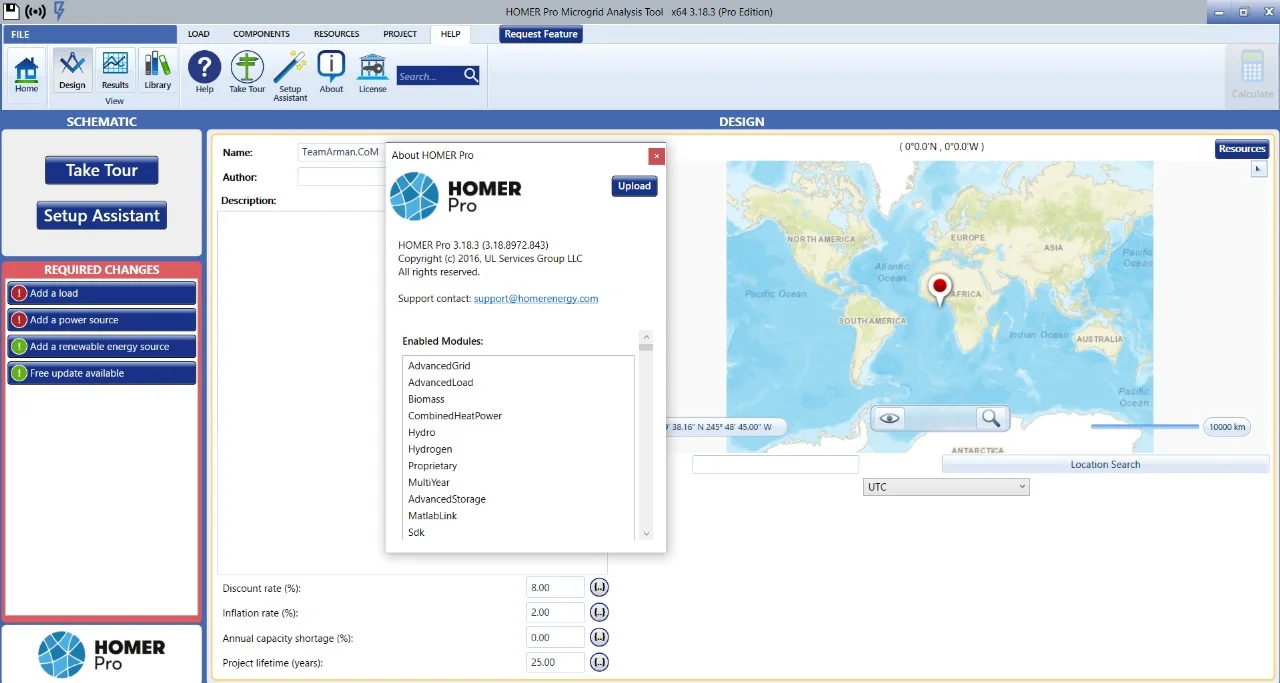
Updated UI: The interface now features the new ULTRUS logo, reflecting the company’s integration with UL Solutions.
-
Optimizer Support for Electrolyzers: A significant technical addition is that the HOMER Optimizer now works with the electrolyzer component. This allows for more sophisticated optimization of systems that produce hydrogen from renewable energy.
-
Enhanced Usability: New context help has been added to guide users, and a feature request button has been integrated directly into the interface to facilitate user feedback.
-
Bug Fix: The release fixed a bug to ensure that the optimization sizing works correctly for hydrogen loads, aligning it with the established process for electric loads.
System Requirements
To ensure HOMER Pro v3.18.4 runs smoothly, your system should meet the following requirements:
| Component | Minimum Requirement |
|---|---|
| Operating System | Windows Vista, 7, 8, 8.1, 10, or higher |
| Processor | Multi-core Intel Series or above, Xeon, or AMD equivalent |
| RAM | 4 GB (8 GB or more is recommended) |
| Hard Disk Space | 4 GB or more is recommended |
| Framework | Windows with the .NET 4.6 framework |
| macOS Support | Mac systems can run HOMER Pro with an appropriate Windows emulator (e.g., Parallels), but this setup is not officially supported. |
Installation Guide
The installation process for HOMER Pro is straightforward, but it requires a user account. Here is a step-by-step guide:
-
Create an Account: Go to the HOMER Energy website and click “Sign In” or “Register Now & Get Your Free Trial” to create a user account and confirm your email address.
-
Complete Your Profile: Before downloading, you may be asked to complete your user profile.
-
Download the Installer: Once logged in, navigate to the HOMER Pro download page. Read and agree to the End User Agreement, and click the “Download HOMER Pro” button. Ensure you select the correct version (64-bit is recommended for most users).
-
Run the Installer: Open the downloaded .zip file and run the installation file (e.g.,
HomerPro-x.x.x.msi). Follow the on-screen instructions to complete the installation. -
License Your Software: Upon first launch, you will be prompted to manage your license. You can activate a purchased license, start a free trial, or use an existing license file.
How to Use the Software
HOMER Pro is designed for a user-friendly workflow, even for complex models. The typical process involves a few key steps, as outlined in the official Getting Started Guide:
-
Create a New Project and Define the Load: Begin by creating a new project and adding an electric load profile. This defines the energy demand that your microgrid needs to meet.
-
Add Components: Add and configure the components for your system, such as a diesel generator, PV array, wind turbines, batteries, and a system converter.
-
Configure Cost Tables: For each component, define the capital, replacement, and operations & maintenance (O&M) costs. This data is crucial for the economic analysis.
-
Run the Simulation: Click “Calculate” to simulate the operation of all feasible system combinations. The software will simulate thousands of configurations, calculating their NPC and LCOE.
-
Optimize the Design: Use the “Search Space” feature to optimize the number of components (e.g., number of batteries or PV modules) to find the most cost-effective combination.
-
Analyze Results: Review the results to compare different system designs. You can view detailed reports on financial performance, energy production, emissions, and more.
Best Use Cases
HOMER Pro is the standard tool for a wide range of microgrid and hybrid power projects:
-
Remote and Off-Grid Communities: The software was originally designed to optimize power systems for remote villages and continues to be a leading tool for this purpose. It is used extensively in projects funded by programs like the Indigenous Off-Diesel Initiative in Canada to reduce diesel dependence in remote First Nations and Inuit communities.
-
Island Utilities: For non-interconnected island grids (e.g., in Hawaii or the Caribbean), HOMER Pro helps analyze and plan the transition to higher renewable energy penetration.
-
Grid-Connected Commercial and Industrial Sites: Businesses, campuses, and military bases can use HOMER Pro to model a microgrid to back up an unreliable grid connection or to reduce energy costs by incorporating renewables and storage.
-
Research and Academia: HOMER Pro is a primary tool for research, with hundreds of academic papers referencing its use. A 2024 study from the IEA PVPS Task 18 program even compared HOMER Pro’s results to measurement data from a real-world microgrid.
-
Feasibility Studies and Project Financing: By providing industry-standard outputs like LCOE, total NPC, and emissions reductions, HOMER Pro generates the credible data required for securing project financing and meeting the reporting requirements of government and private funding programs.
Advantages and Limitations
While HOMER Pro is the industry leader, it has distinct advantages and limitations.
Advantages
-
Industry Standard: It is the most widely recognized and used software for microgrid optimization, providing a common language for project stakeholders.
-
Comprehensive Modeling: It can model a wide array of components and configurations, from simple diesel generators to complex hybrid systems with PV, wind, batteries, and hydrogen.
-
Validated by NREL: Its origin at NREL and its long track record of use in real-world projects give it a high level of trust and credibility.
-
Strong Developer Support: As part of UL Solutions, the software has robust, ongoing development and support.
Limitations
-
Algorithm Rigidity: HOMER Pro’s optimization algorithms may not be as flexible as some emerging tools. A recent study comparing it to a custom MILP-based algorithm (HyMGP) found that HyMGP could offer more optimal and flexible solutions by allowing stricter user-defined constraints.
-
Windows-Only: The software is built for Windows. Mac users must rely on unsupported emulation setups.
-
Cost: As a premium commercial software, the licensing cost can be a barrier, especially for individuals or small projects.
-
Potential for Different Results: Studies show that while HOMER Pro matches real-world data well, different optimization tools can produce slightly different optimum system sizes for the same inputs, so results should be used for informed decision-making rather than absolute truth.
Alternatives to HOMER Pro
Several other software tools can be used for microgrid design and optimization, each with its own strengths and weaknesses.
| Software | Key Features | Best For |
|---|---|---|
| iHOGA PRO+ | Uses genetic algorithms, similar to HOMER, but can yield slightly different optimization results. | Users wanting to compare results against HOMER or who prefer a genetic algorithm approach. |
| RETScreen | A clean energy management software focused on feasibility analysis and project finance, less detailed in techno-economic optimization. | Early-stage feasibility studies and financial analysis. |
| System Advisor Model (SAM) | A free, NREL-developed tool with detailed performance models for renewable energy systems. | Detailed performance modeling for specific technologies, especially solar and storage. |
| HyMGP | A newer, MILP-based tool that has shown potential for providing more optimal and flexible solutions than HOMER Pro in academic studies. | Research and specialized projects where maximum optimization precision is required. |
Frequently Asked Questions
What is HOMER Pro used for?
HOMER Pro is the global standard software used for modeling, optimizing, and analyzing microgrids and other distributed energy systems. It helps engineers and planners design cost-effective and reliable power systems that integrate renewable energy, storage, and conventional generation.
What are the system requirements for HOMER Pro v3.18.4?
The software requires a Windows operating system (Vista or higher), a multi-core processor, a minimum of 4GB of RAM, and the .NET 4.6 framework. Mac systems can run it via an unsupported Windows emulator.
Is there a free trial for HOMER Pro?
Yes, HOMER Energy offers a free trial. To access it, you need to create a user account on the HOMER Energy website, which will allow you to download and install the software.
What is the difference between HOMER Pro and HOMER Grid?
HOMER Pro is designed for optimizing microgrids in all sectors, including off-grid and grid-connected backup systems. HOMER Grid, in contrast, was built specifically to optimize grid-connected systems, focusing on maximizing the financial benefit from selling excess energy back to the grid.
How is HOMER Pro related to NREL?
HOMER was originally developed at the National Renewable Energy Laboratory (NREL) in 1993. While the commercial product is now owned by UL Solutions, the software’s core algorithms and team are rooted in the expertise developed at NREL.
What’s new in HOMER Pro version 3.18.4?
The latest version, released in November 2024, includes an updated UI with the new ULTRUS logo, adds optimizer support for electrolyzers, improves context help, and fixes a sizing bug related to hydrogen loads.
Final Thoughts
HOMER Pro v3.18.4 remains the unrivaled global standard for microgrid optimization. Its 30-year heritage, validated by decades of real-world application, makes it an indispensable tool for anyone involved in planning, designing, or financing distributed energy systems. The latest version solidifies this position by refining its feature set, particularly for emerging technologies like hydrogen, while maintaining the powerful simulation and optimization capabilities that professionals have relied on for years. Whether you are electrifying a remote village, managing a university campus, or analyzing the feasibility of a large-scale renewable project, HOMER Pro provides the credible, data-driven insights necessary for confident decision-making.