

Overview of DEEPSOIL v7.1.10
Table of Contents
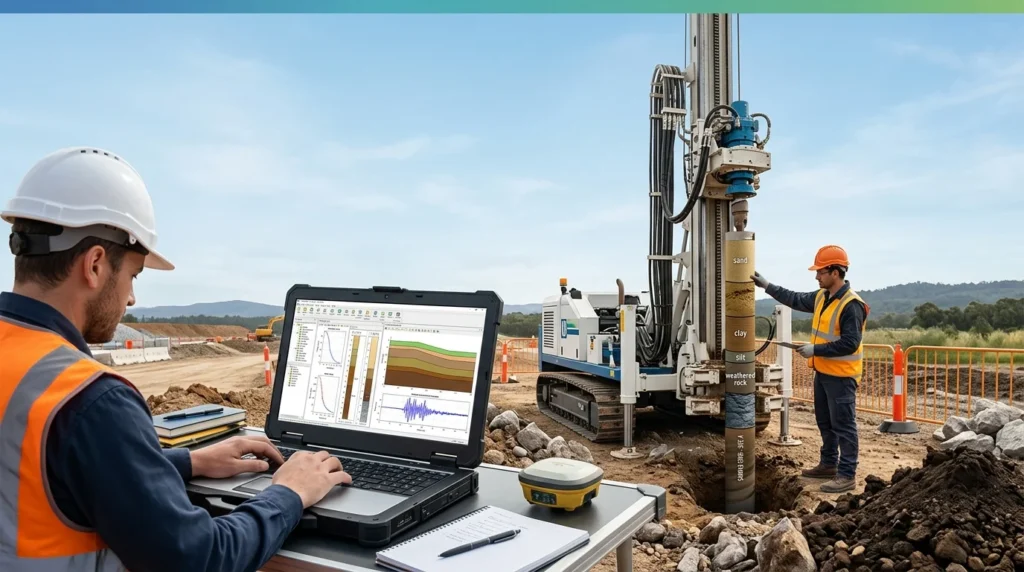
DEEPSOIL is a specialized engineering program designed to model the behavior of soil layers under earthquake loading conditions. Developed under the direction of Professor Youssef M.A. Hashash at the University of Illinois at Urbana-Champaign, DEEPSOIL has become a standard tool in the geotechnical earthquake engineering community since its initial release.
The software discretizes the soil column using a multi-degree-of-freedom lumped parameter model. Nonlinear analysis is performed by solving equations of motion in the time domain using the Newmark β method (implicit integration scheme). This approach allows engineers to capture complex soil behaviors that simpler equivalent linear methods cannot fully represent.
DEEPSOIL v7.1.10 represents the latest iteration of this platform, offering enhanced stability, improved numerical algorithms, and expanded constitutive modeling capabilities. The software is freely available for academic and professional use through the University of Illinois website.
Key Terminology for Site Response Analysis
-
Site Response Analysis (SRA): Evaluation of how seismic waves travel vertically through soil layers
-
Equivalent Linear Analysis: Frequency-domain method using iteration to match strain-compatible soil properties
-
Nonlinear Analysis: Time-domain method that directly models soil stress-strain behavior
-
Modulus Reduction Curve: Relationship showing how shear modulus decreases with increasing strain
-
Damping Curve: Relationship showing how material damping increases with strain
Key Features of DEEPSOIL v7.1.10
DEEPSOIL offers a comprehensive suite of features for seismic site response analysis:
Analysis Methods
-
1D Equivalent Linear Analysis: Frequency-domain approach with iterative strain-compatible properties
-
1D Nonlinear Time-Domain Analysis: Direct integration of equations of motion with advanced constitutive models
-
Linear Analysis: Elastic wave propagation for simple site conditions
-
Porewater Pressure Modeling: Generation and dissipation of excess pore pressures during shaking
Constitutive Soil Models
-
GQ/H Model (General Quadratic/Hyperbolic): Advanced backbone curve formulation with shear strength control by Groholski et al. (2016)
-
MRDF Technique: Modulus Reduction and Damping Formulation by Phillips & Hashash (2009) that improves fit to damping behavior
-
Darendeli (2001) Reference Curves: Widely validated empirical curves for modulus reduction and damping
-
Seed & Idriss (1970) Curves: Classic formulation for sandy soils
-
Vucetic & Dobry (1991) Curves: Plasticity index-based models for clayey soils
Damping Formulations
-
Frequency-Independent Damping: Advanced formulation that avoids frequency-dependent artifacts
-
Rayleigh Damping: Multiple formulation types available
-
Small-Strain Damping: Independent control of viscous damping at low strains
Additional Capabilities
-
Batch Run Analysis: Process multiple ground motions simultaneously
-
Parallel Processing: Leverage multi-core processors for faster computations
-
Excel File Generation: Export results for further analysis
-
Interactive Graphical User Interface: 5–6 stage workflow guiding users through complete analysis
What’s New in DEEPSOIL v7.1.10
The v7.1.10 release represents a significant update to the DEEPSOIL platform, incorporating improvements based on user feedback and advances in soil dynamics research.
Enhancements Over Previous Versions
-
Improved GQ/H Constitutive Model: Enhanced curve-fitting procedures for automatic shear strength correction
-
Updated Modulus Reduction and Damping Curves: Inclusion of Darendeli (2001) reference curves with shear strength correction
-
Enhanced Numerical Stability: Refined integration algorithms for nonlinear analysis
-
Expanded Output Capabilities: Additional visualization options for stress-strain loops and pore pressure ratios
-
Updated User Interface: Modernized .NET-based graphical interface components
Known Differences from Other Software
Research comparing DEEPSOIL with LS-DYNA for nonlinear site response analysis indicates that DEEPSOIL may show abrupt variations in peak strains of consecutive soil layers. However, the corresponding acceleration responses are reasonably close to those calculated from LS-DYNA, indicating that this behavior does not significantly affect the overall acceleration response.
System Requirements for DEEPSOIL v7.1.10
DEEPSOIL is designed to run on standard Windows-based workstations. The software requires familiarity with seismic site response analysis theory and methodologies, as well as geotechnical earthquake engineering concepts.
Minimum Requirements
-
Operating System: Windows 7, Windows 8, or Windows 10 (64-bit recommended)
-
Processor: Intel Core i3 or equivalent AMD processor
-
RAM: 4 GB minimum
-
Storage: 500 MB available disk space
-
Display: 1024 × 768 resolution or higher
-
.NET Framework: Version 4.5 or later
Recommended Configuration
-
Processor: Intel Core i5 or i7 (or AMD equivalent) with multiple cores
-
RAM: 8 GB or more for large models with many soil layers
-
Storage: SSD for faster file operations and analysis
-
Display: 1920 × 1080 resolution for optimal GUI experience
Note: DEEPSOIL v7.1.10 has been tested primarily on Windows platforms. Users requiring Linux or macOS compatibility may need to run the software through virtualization or compatibility layers, though official support for these platforms is limited.
Installation Guide for DEEPSOIL v7.1.10
Installing DEEPSOIL is straightforward. Follow these steps to set up the software on your workstation:
Step-by-Step Installation
-
Download the Installer: Visit the official University of Illinois DEEPSOIL website at https://deepsoil.cee.illinois.edu/ to obtain the latest version.
-
Verify System Compatibility: Ensure your computer meets the minimum system requirements listed above.
-
Run the Installer: Right-click the downloaded file and select “Run as Administrator” to ensure proper installation.
-
Follow Installation Wizard: Accept the license agreement and choose your installation directory. The default location is typically
C:\Program Files\DEEPSOIL\. -
Complete Installation: Click “Finish” when the wizard completes. A shortcut should appear on your desktop.
-
Launch the Software: Double-click the DEEPSOIL icon to start the application. The graphical user interface should open within a few seconds.
Post-Installation Setup
-
User Manual Access: The complete user manual and tutorial are available through the Help menu
-
Example Files: Sample models are included to help new users learn the workflow
-
License Activation: Academic and professional users may need to register for a license depending on usage type
How to Use DEEPSOIL v7.1.10
DEEPSOIL’s graphical user interface guides users through a structured workflow. The software organizes the analysis process into 5 stages for equivalent linear analysis and 6 stages for nonlinear analysis.
Complete Workflow Overview
Stage 1: Analysis Type Selection
Choose between:
-
Linear frequency-domain analysis
-
Equivalent linear frequency-domain analysis
-
Nonlinear time-domain analysis
Stage 2: Soil Profile and Material Properties
-
Define the number of soil layers
-
Input layer thickness, unit weight, and shear wave velocity
-
Assign modulus reduction and damping curves to each layer
-
Select constitutive models (GQ/H, MRDF, or user-defined)
Stage 3: Rock Properties and Boundary Conditions
-
Define elastic rock properties at the base
-
Specify input motion location (within or outcropping)
-
Set boundary conditions for the soil column
Stage 4: Analysis Control
-
Select time-domain or frequency-domain analysis
-
Configure iteration parameters for equivalent linear analysis
-
Set convergence criteria and maximum number of iterations
Stage 5: Motion and Output Control
-
Import ground motion records (PEER NGA format supported)
-
Apply baseline correction and filtering
-
Select output quantities (acceleration, stress-strain, pore pressure)
-
Configure output depth profiles
Stage 6: Viscous Damping Formulation (Nonlinear Only)
-
Select damping formulation type
-
Choose target modes/frequencies
-
Verify damping behavior across frequency range
-
Update stiffness matrix as needed
Interpreting Results
After running the analysis, DEEPSOIL provides comprehensive outputs:
-
Acceleration Time Histories: At each soil layer boundary
-
Response Spectra: 5%-damped elastic response spectra
-
Shear Stress-Strain Loops: Hysteretic behavior visualization
-
Transfer Functions: Frequency-dependent amplification
-
Excess Pore Pressure Ratios: For nonlinear analyses with pore pressure modeling
-
PGA Profiles: Peak ground acceleration versus depth
Best Use Cases for DEEPSOIL
DEEPSOIL excels in a variety of geotechnical earthquake engineering applications:
1. Seismic Hazard Assessment
Evaluate how local soil conditions amplify or deamplify bedrock ground motions. Critical for developing design response spectra for building codes.
2. Site Classification
Determine site class (A through F) based on shear wave velocity profiles and site response characteristics.
3. Liquefaction Analysis
Model excess porewater pressure generation and dissipation in saturated sandy soils during seismic loading.
4. Foundation Design
Provide free-field ground motions for soil-structure interaction analyses and foundation design.
5. Research and Academia
Study nonlinear soil behavior, validate constitutive models, and conduct parametric studies on site response.
6. Nuclear Facility Design
Assess site response for safety-related nuclear structures, though users should be aware of limitations regarding peak strain variations.
Advantages and Limitations of DEEPSOIL
Key Advantages
-
Free Academic Use: No licensing costs for educational institutions and researchers
-
Advanced Constitutive Models: GQ/H model provides automatic shear strength correction
-
Comprehensive Damping Options: Frequency-independent damping formulation reduces artifacts
-
Pore Pressure Capabilities: Full generation and dissipation modeling
-
User-Friendly Interface: Guided workflow with graphical input and output
-
Batch Processing: Efficient analysis of multiple ground motions
Important Limitations
-
1D Only: Cannot capture 2D/3D site effects such as basin edge effects or surface wave generation
-
Peak Strain Variations: May produce abrupt variations in peak strains of consecutive layers
-
Less Conservative Estimates: Nonlinear hysteretic model generally yields less conservative results than equivalent linear approaches like SHAKE2000
-
Windows-Only: Limited support for macOS and Linux platforms
-
Steep Learning Curve: Requires solid understanding of soil dynamics theory
Alternatives to DEEPSOIL
Several other software packages are available for site response analysis. Each offers distinct features and trade-offs:
SHAKE2000
The classic equivalent linear frequency-domain program. Produces the most conservative results compared to nonlinear methods. Best for routine design where conservatism is desired. SHAKE2000 uses equivalent linear shear modulus and damping ratio in its iterative formulation.
LS-DYNA
A general-purpose finite element program with soil constitutive models including MAT_079. Comparison studies show DEEPSOIL and LS-DYNA produce reasonably similar acceleration responses, though LS-DYNA occasionally generates high-frequency acceleration noise that requires smoothing.
NERA (Nonlinear Earthquake Response Analysis)
Implements Iwan-Mroz hysteretic models with formulations based on Seed & Idriss (1970) for sands and Sun et al. (1988) for clays. Unlike DEEPSOIL, NERA lacks shear strength correction models.
DMOD2000
Another equivalent linear program similar to SHAKE2000. Studies show SHAKE2000 and DMOD2000 produce very similar results, while DEEPSOIL offers a theoretical advantage through its advanced damping algorithm.
PLAXIS 2D
Geotechnical finite element software capable of 2D site response analysis. More complex to set up than DEEPSOIL but captures 2D effects including basin geometry and lateral heterogeneity.
OpenSees
Open-source finite element framework with soil constitutive models. Highly flexible but requires programming knowledge and significant setup effort.
Frequently Asked Questions About DEEPSOIL v7.1.10
What is DEEPSOIL used for?
DEEPSOIL is used for one-dimensional site response analysis in geotechnical earthquake engineering. It simulates how seismic waves propagate through horizontally layered soil deposits, calculating ground shaking intensity, soil amplification, and porewater pressure generation during earthquakes.
Is DEEPSOIL free to download and use?
Yes, DEEPSOIL is freely available for academic and professional use. It is developed at the University of Illinois at Urbana-Champaign and distributed through their official website at deepsoil.cee.illinois.edu.
What is the difference between equivalent linear and nonlinear analysis in DEEPSOIL?
Equivalent linear analysis operates in the frequency domain and uses iterative strain-compatible soil properties. Nonlinear analysis operates in the time domain and directly models soil stress-strain behavior using advanced constitutive models like GQ/H. Nonlinear analysis is more accurate for strong shaking conditions.
Can DEEPSOIL model liquefaction?
Yes, DEEPSOIL includes porewater pressure generation and dissipation models. These capabilities allow users to simulate excess pore pressure buildup in saturated soils during seismic loading, which is essential for liquefaction assessment.
How does DEEPSOIL compare to SHAKE2000?
SHAKE2000 uses equivalent linear analysis and generally produces more conservative results. DEEPSOIL’s nonlinear hysteretic model typically yields less conservative estimates but provides a more physically accurate representation of soil behavior during strong shaking.
What soil constitutive models are available in DEEPSOIL?
DEEPSOIL supports multiple constitutive models including the GQ/H (General Quadratic/Hyperbolic) model with shear strength control, the MRDF technique for improved damping behavior, and reference curves from Darendeli (2001), Seed & Idriss (1970), and Vucetic & Dobry (1991).
What are the system requirements for DEEPSOIL v7.1.10?
DEEPSOIL runs on Windows operating systems. Minimum requirements include a multi-core processor, 4 GB RAM, and 500 MB storage. Recommended configuration includes 8 GB RAM and an SSD for optimal performance.
Can DEEPSOIL perform 2D or 3D site response analysis?
No, DEEPSOIL is limited to one-dimensional analysis. For 2D or 3D site response analysis, users should consider alternatives such as PLAXIS 2D, FLAC, or OpenSees.
Final Thoughts
DEEPSOIL v7.1.10 remains a cornerstone tool in geotechnical earthquake engineering. Its combination of advanced constitutive models, comprehensive damping formulations, and user-friendly interface makes it invaluable for site response analysis. The software’s free availability for academic and professional use has democratized access to sophisticated seismic analysis capabilities.
For engineers and researchers working on seismic hazard assessment, site classification, and foundation design, DEEPSOIL provides a robust platform for understanding how soil conditions influence ground shaking. While limitations exist—particularly its 1D nature and Windows-only compatibility—the software’s strengths in modeling nonlinear soil behavior and porewater pressure generation make it an essential addition to any geotechnical engineer’s toolkit.
Whether you are a student learning site response analysis or a practicing engineer evaluating seismic site conditions, DEEPSOIL v7.1.10 offers the analytical depth and practical usability needed to make informed engineering decisions. Download the latest version from the official University of Illinois website to begin your site response analysis projects today.
Our Paid Service