


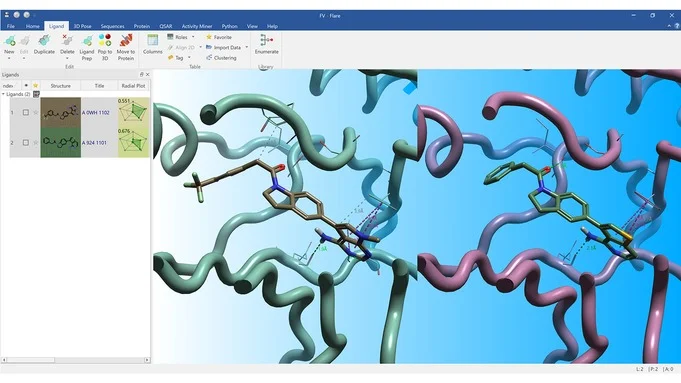
Overview of Cresset Flare
Table of Contents
Cresset Flare is a comprehensive drug design platform used globally to accelerate small molecule discovery . It integrates ligand-based and structure-based methods within a single, collaborative environment, empowering researchers to discover, design, and predict the biological activity of novel molecules . By combining physics-based simulation, purposeful AI, and proven scientific expertise, Flare helps streamline discovery from target validation to candidate selection .
Flare serves as a complete molecular design solution, allowing teams to manage data, workflows, and ideas in one place . Its collaborative design makes it easy for medicinal chemists to access the power of computational chemistry, fostering data sharing and innovation across departments .
Key Features
Flare’s comprehensive toolset addresses the full spectrum of drug discovery workflows. Its key features include:
-
Free Energy Perturbation (FEP): A cornerstone of the platform for calculating relative binding affinities, enabling accurate ranking of molecules in a congeneric ligand series . Flare V12 enhances this with a new simulation engine for greater speed and flexibility .
-
Protein-Ligand Docking: This uses the Lead Finder engine to predict binding poses and interactions with high accuracy . It supports docking of both covalent and non-covalent ligands and features unique tools like “Flickering Waters” to model the role of water molecules in binding sites .
-
Molecular Dynamics (MD): Flare uses the OpenMM engine for studying protein conformational changes and assessing the stability of protein-ligand complexes over time . Flare V12 extends these capabilities to handle covalent ligands, non-standard amino acids, and post-translationally modified proteins .
-
Water Analysis: Tools like 3D-RISM and GIST (Grid Inhomogeneous Solvation Theory) help identify tightly bound water molecules in protein active sites and those that are energetically unfavorable to displace, informing ligand design .
-
Generative Chemistry: Flare features an AI integration layer called MolGenAI, which combines the power of generative AI with Flare’s robust physics-based evaluation to generate novel, diverse, and drug-like molecules .
-
AI Assistant: New in Flare V11 and carried forward, the AI Assistant enhances productivity by providing a “how-to” chat function and a coding copilot. This enables researchers to create custom workflows via natural language commands, reducing barriers for users with varying programming experience .
-
Spark Bioisostere Replacement: Integrated within Flare, Spark uses field-based technology to suggest novel bioisosteric replacements and scaffold hops, igniting chemical creativity .
-
QSAR Modeling: Advanced QSAR models, including Gradient Boosting, are available for predicting activity and ADMET properties of new compounds .
What’s New in Flare V12
Flare V12 is a focused release designed to overcome the traditional barriers to adopting FEP in routine drug discovery. The key updates include:
Faster FEP Calculations
A major limitation of FEP has been its high computational cost and long runtimes. Flare V12 introduces a new simulation engine and workflow that cuts calculation times by over 50% compared to the previous version . This speed increase allows teams to evaluate more compounds in less time, enabling faster, more agile decision-making in compound prioritization .
Expanded Applicability to Complex Chemistry
Flare V12 significantly broadens the chemical space that FEP can accurately model . The new release adds support for:
-
Ring-Breaking Transformations: This enables researchers to model scaffold hopping, cyclizations, and ring size modifications in a single FEP calculation. This is crucial for common medicinal chemistry changes that were previously difficult to model .
-
Advanced Conformational and Water Sampling: To improve predictive accuracy, Flare FEP now incorporates methods like Replica Exchange for broader conformational sampling and Grand Canonical Monte Carlo for enhanced water sampling, particularly in buried binding sites .
Enhanced Molecular Dynamics Capabilities
Beyond FEP, Flare V12 extends its core Molecular Dynamics capabilities to support covalent ligands, non-standard amino acids, and post-translationally modified proteins . This is increasingly important in areas like targeted covalent therapeutics and peptide drug design. In Flare V12, parameters for these complex systems are automatically calculated and seamlessly applied in simulations, simplifying previously complex setup procedures .
System Requirements
The specific system requirements for Cresset Flare V12 (x64) are typically provided upon purchase and may vary based on the scale of operations. However, given its intensive computational tasks, researchers should prepare a robust hardware environment.
While the exact specifications for V12 are not publicly listed, the software is designed to run on 64-bit (x64) Windows and Linux operating systems. To leverage the accelerated performance of Flare V12’s FEP simulations, a system equipped with modern, high-performance NVIDIA GPUs is highly recommended for optimal calculation times .
Installation Guide
Installation of Cresset Flare is a straightforward process managed through the Cresset installer.
-
Acquire the Installer: Download the official Flare V12 (x64) installer from your Cresset account portal or provided media.
-
Run the Installer: Launch the installer on your Windows or Linux system. Administrative or root privileges may be required.
-
License Activation: During installation, you will be prompted to enter your license server information or a license file provided by Cresset. Flare requires a valid, legally obtained license to operate.
-
Follow Prompts: Follow the on-screen instructions to complete the installation.
-
Launch: Once installed, you can launch Flare from your applications menu or desktop shortcut.
How to Use Flare
Flare is designed as an integrated platform, allowing users to seamlessly combine different methods in a single workflow . A typical workflow might involve:
-
Ligand Preparation and Analysis: Start by importing ligand structures to prepare 3D structures, and use tools to analyze activity data.
-
Structure-Based Design: If a protein structure is available (e.g., from the PDB), use Flare’s protein preparation tools.
-
Docking: Dock your ligand library into the protein active site to predict binding modes and interactions, using tools like “Flickering Waters” to account for water molecules .
-
Advanced Simulation:
-
Run Molecular Dynamics to study the stability of protein-ligand complexes and protein flexibility .
-
Conduct FEP calculations to accurately rank compounds by their predicted binding affinity .
-
-
Idea Generation: Use Spark or MolGenAI to explore new chemical space and generate novel ideas for synthesis .
-
Analysis and Iteration: Use Flare’s visualization tools to analyze results, structure-activity relationships (SAR), and decide which compounds to prioritize.
Best Use Cases
Flare is a versatile platform suitable for a wide range of drug discovery applications:
-
Hit-to-Lead Optimization: Researchers can rapidly evaluate new designs in silico, prioritizing the most promising molecules for synthesis and testing, thus streamlining the optimization process .
-
Lead Optimization: Flare FEP is a core tool for accurately ranking lead series, enabling chemists to focus resources on the most potent compounds and reduce the number of synthesized analogs .
-
Scaffold Hopping and Novel Molecule Generation: Using Spark and the generative chemistry tools, discovery teams can explore new chemical space and identify novel chemotypes with desired activity .
-
Studying Protein-Protein Interactions (PPIs): Flare’s docking and MD tools can be used to model and understand the interactions between proteins, a challenging but important area for drug discovery .
-
Covalent Drug Design: Flare V12’s improved support for covalent ligands in MD simulations makes it a valuable tool for designing targeted covalent therapeutics .
Advantages and Limitations
Advantages
-
Integrated Platform: Combines a wide array of computational tools (docking, FEP, MD, QSAR, generative AI) into a single user-friendly interface .
-
Accelerated Workflows: Flare V12’s faster FEP engine significantly reduces computational runtimes, allowing for more rapid iteration .
-
Broad Applicability: Supports modeling complex chemical transformations (e.g., ring-breaking) and systems (e.g., covalent ligands), expanding the scope of what can be studied .
-
AI-Enhanced Productivity: The AI Assistant and generative chemistry tools make advanced techniques accessible to a wider range of scientists and boost overall efficiency .
Limitations
-
Computational Cost: While Flare V12 is faster, FEP and MD remain computationally demanding and require significant hardware investment, particularly in high-performance GPUs .
-
Expertise Required: Although the interface is designed to be intuitive, obtaining meaningful results from advanced methods still requires a solid understanding of computational chemistry and drug design principles .
-
Licensing Cost: As a premium enterprise software, a Flare license represents a significant financial investment, which may be a barrier for smaller organizations or academic labs.
Alternatives to Cresset Flare
Several other software suites offer CADD capabilities, but they differ significantly in their approach and key features.
-
Schrödinger (Maestro): A highly popular and comprehensive suite offering a wide range of tools, including the widely used FEP+ method. While powerful, it may have a steeper learning curve and a different licensing model.
-
OpenEye Scientific (Orion): Known for its robust and high-performance tools for structure-based design and cheminformatics, particularly its docking and shape-based methods. It offers powerful cloud-based solutions.
-
Chemical Computing Group (MOE): A long-established platform that is highly versatile and widely used in both academia and industry for a broad range of molecular modeling tasks, from structure preparation to pharmacophore modeling.
-
BIOVIA Discovery Studio: An enterprise-level platform that provides a comprehensive set of tools for life sciences, including QSAR, pharmacophore modeling, and structure-based design, often used in large pharmaceutical companies.
Flare distinguishes itself with its strong focus on field-based and electrostatic technologies (e.g., the proprietary Electrostatic Complementarity method), its integrated AI features, and its user-friendly design that makes advanced science accessible to medicinal chemists .
Frequently Asked Questions
What is Free Energy Perturbation (FEP) used for?
FEP is a computational method used in drug discovery to accurately predict the relative binding affinity of a series of related compounds to a protein target . This allows medicinal chemists to prioritize which molecules are likely to be most potent before they are synthesized, saving significant time and resources .
How much faster are FEP calculations in Flare V12?
Flare V12 introduces a new simulation engine that cuts calculation times by more than 50% compared to the previous version, while maintaining excellent predictive performance .
What is the Flare AI Assistant?
The AI Assistant is an AI-powered tool in Flare that has two main modes: a Chat mode that answers “how-to” questions about the software, and a Code (Copilot) mode that writes and explains Python code for custom workflows based on natural language commands .
What is Spark in Cresset Flare?
Spark is a powerful bioisosteric replacement and scaffold hopping tool integrated within Flare . It uses Cresset’s patented field-based technology to find novel and diverse chemical structures that can replace a part of a lead molecule, helping to generate new intellectual property and improve compound properties .
Can Flare handle covalent ligands?
Yes, Flare is well-equipped to handle covalent ligands. It offers specific docking methods for covalent inhibitors . The latest version, Flare V12, has also extended its Molecular Dynamics capabilities to better support covalent ligands and other complex systems .
Is Flare suitable for someone without a computational chemistry background?
Yes, Cresset Flare is designed to be user-friendly for medicinal chemists and researchers without deep computational expertise . Its intuitive interface, visual feedback, and new AI Assistant guide users through complex tasks, making powerful science accessible .
Final Thoughts
Cresset Flare V12 is a significant release that tackles the core challenge of drug discovery: making the right molecules. By dramatically improving the speed and applicability of FEP, it empowers computational and medicinal chemists to break free from slow, resource-intensive synthesis cycles .
The integration of a faster FEP engine with cutting-edge AI features like the AI Assistant and generative chemistry, all within a platform designed for collaboration, solidifies Flare’s position as a leading digital molecular discovery solution . For teams looking to navigate the complex landscape of drug design and make data-driven decisions with confidence, Cresset Flare V12 provides the tools to discover and design better molecules, faster.
Our Paid Service
“We do not sell or provide any software. We only offer professional support services. If any software on your system is not working properly, or you are facing installation errors, crashes, or any other technical issue — just contact us. We will help you fix the problem quickly and remotely via AnyDesk. No software will be provided from our side — only expert troubleshooting and support.”