
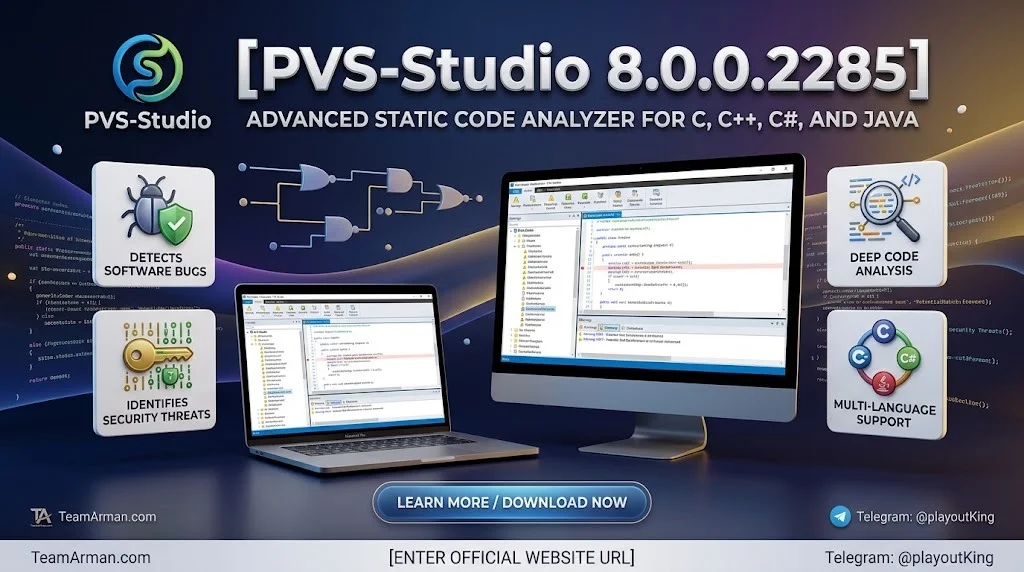
Overview of PVS-Studio 8.0.0.2285
Table of Contents
PVS-Studio is a static analysis tool developed by PVS-Studio LLC. It works by automatically “reading” the source code of a program without executing it, identifying errors, potential vulnerabilities, and other issues before testing even begins. The tool integrates seamlessly into development environments and CI/CD pipelines, allowing teams to catch defects at the earliest and least expensive stage of development.
The version 8.0.0.2285 release represents a major milestone in the product’s evolution. While previous versions focused primarily on C, C++, C#, and Java, this release extends the analyzer’s reach to JavaScript, TypeScript, and Go. This makes PVS-Studio an attractive choice for companies with mixed technology stacks, offering a single vendor and a single point of technical support instead of requiring separate tools for each language.
PVS-Studio operates on Windows, Linux, and macOS, and supports analysis for cross-platform compilers targeting 32-bit, 64-bit, and embedded ARM platforms. The tool is available as a B2B solution and is used by development teams and companies worldwide.
Key Features
PVS-Studio 8.0.0.2285 comes packed with features designed to support modern software development workflows. Here are the most important capabilities:
-
Multi-language analysis: Detect bugs and security weaknesses in C, C++, C#, Java, JavaScript, TypeScript, and Go from a single tool.
-
SAST capabilities: Identify potential security vulnerabilities through taint analysis and other security-focused diagnostics.
-
Data-flow analysis: Trace how values move and change through code to uncover complex, path-dependent faults.
-
Symbolic execution: Detect defects that only manifest under specific execution paths.
-
Industry standards compliance: Diagnostics are mapped to CWE, SEI CERT, OWASP, and MISRA standards, simplifying audit and certification preparation.
-
Multiple integration points: Work as an IDE plugin, a command-line tool, or an automated server-side analysis solution.
-
Incremental analysis mode: Automatically analyze only modified code after a build to speed up CI pipelines.
-
Pull request integration: Run analysis on pull/merge requests to catch issues before they enter the main codebase.
-
Unified configuration: A single TOML-based configuration file format ensures consistent analysis results across developer machines, build servers, and contractors.
Diagnostic Rule Coverage
The tool includes hundreds of diagnostic rules across all supported languages. For the newly added JavaScript, TypeScript, and Go analyzers, each language includes approximately 40 general-purpose diagnostic rules plus one OWASP-related rule. These rules target defects that are difficult to spot during code review, such as equivalent operands in conditions, unreachable code, infinite recursion, type conversion errors, incorrect format strings, and improper loop counter handling.
What’s New in PVS-Studio 8.0.0.2285
The 8.0.0.2285 release introduces several significant changes and improvements. Here is a breakdown of the most notable updates:
New Language Analyzers
The headline feature of this release is the addition of analyzers for JavaScript, TypeScript, and Go. These analyzers work both from the command line and within supported IDEs, allowing developers to check their code without leaving their preferred environment.
New IDE Plugins
Alongside the new language analyzers, PVS-Studio 8.0.0.2285 introduces plugins for WebStorm and GoLand. The extension for Visual Studio Code has also been extensively updated and now supports all programming languages covered by PVS-Studio.
MISRA C++ 2023 Support
Work on expanding MISRA C++ 2023 coverage continues. In this release, sixteen existing diagnostic rules of the MISRA group have been adapted to the MISRA C++ 2023 standard.
Compiler Support Expansion
Support for triplets has been extended for the g++ compiler (x86_64-pc-linux-gnu-c++) on Linux. Support has also been added for the TI C2000-CGT compiler in compilation monitoring and compilation trace modes.
Other Improvements
-
The PVS-Studio plugin is now available for Qt Creator 20.x, while support for Qt Creator 14.x has been discontinued.
-
The Java analyzer now correctly handles projects with complex build structures that use source sets.
-
A new logging system is being implemented to simplify gathering data on issues that occur during analyzer operation.
Breaking Changes
Users upgrading from previous versions should be aware of several breaking changes:
-
For Unreal Engine projects, the
//V_USE_OLD_PARSERflag in the.pvsconfigfile is now ignored. The new C++ parser is now the default for all analyzed projects. -
The Java analyzer now sorts the contents of suppress files, which may cause substantial changes to suppress files stored under version control.
-
Messages for diagnostic rules V2558 and V547 have been updated, which may cause previously suppressed warnings to reappear.
System Requirements
Before installing PVS-Studio 8.0.0.2285, ensure your system meets the following requirements:
Operating System Support
PVS-Studio runs on Windows (x86-64 and ARM), Linux (x86-64), and macOS (Intel and Apple Silicon). For Windows, supported versions include Windows 11, Windows 10, Windows 8, Windows Server 2019, Windows Server 2016, and Windows Server 2012. For Linux, the analyzer requires a 64-bit distribution with kernel version 3.2.0 or higher.
Hardware Requirements
A minimum of 2 GB of RAM is required per processor core, with 4 GB or more recommended. The analyzer benefits from multi-core systems, as more cores lead to faster code analysis.
Software Prerequisites
-
Windows: .NET Framework version 4.7.2 or higher is required. For analyzing .NET, .NET Standard, and .NET Framework SDK-style projects, .NET SDK 9.0 is required.
-
Linux: For the blame-notifier utility, .NET Runtime 10.0 must be installed.
-
Java analysis: A 64-bit Java 8 or later is required to run the Java analyzer.
Supported IDEs
PVS-Studio 8.0.0.2285 integrates with a wide range of development environments:
-
Microsoft Visual Studio 2026, 2022, 2019, 2017, 2015, 2013, 2012, and 2010
-
IntelliJ IDEA, CLion, Rider, WebStorm, GoLand (JetBrains IDEs)
-
Visual Studio Code
-
Qt Creator 20.x
Installation Guide
Installing PVS-Studio 8.0.0.2285 is a straightforward process. The method you choose depends on your operating system and preferred workflow.
Windows Installation
-
Download the PVS-Studio installer (.exe) from the official website.
-
Run the installer with administrator privileges.
-
Follow the on-screen instructions and select the components you need, including any IDE integrations you require.
-
During installation, you can choose to integrate PVS-Studio with Visual Studio Code if desired.
For unattended deployment, you can use command-line parameters such as /verysilent and /suppressmsgboxes.
Installation via Package Managers
PVS-Studio can be installed using popular package managers:
-
Chocolatey:
choco install pvs-studio -
Winget:
winget install --id PVS-Studio.PVS-Studio --exact
IDE Plugin Installation
For JetBrains IDEs such as IntelliJ IDEA, CLion, Rider, WebStorm, and GoLand:
-
Open the settings window by selecting File > Settings > Plugins.
-
Select the Marketplace tab and enter “PVS-Studio” in the search bar.
-
Click Install and restart the IDE when prompted.
For Visual Studio Code, open the Extensions view, search for “PVS-Studio,” and click Install.
Linux and macOS Installation
Download the appropriate package for your distribution from the official website. On Linux, the pvs-studio-analyzer utility supports the x86_64-pc-linux-gnu-c++ compiler triplet.
How to Use PVS-Studio 8.0.0.2285
PVS-Studio can be used in several different modes, depending on your workflow and the stage of development.
Local Analysis on Developer Machines
The most common approach is to run the analyzer locally using an IDE plugin or the command line. This provides the fastest feedback loop, allowing developers to address issues as they write code. Early detection is significantly cheaper than fixing bugs later in the development cycle.
Automated Analysis on Build Servers
For additional protection against errors entering version control, run PVS-Studio regularly on your build server. A two-tier approach—local analysis plus automated server analysis—is recommended for comprehensive coverage.
Incremental Analysis
Use the incremental analysis mode to automatically check only the code that has changed after a build. This optimizes CI pipeline performance and makes pull request reviews more efficient.
Embedded Systems Analysis
PVS-Studio offers specialized mechanisms for embedded projects:
-
Compilation monitoring: CLMonitor.exe (Windows)
-
Wrap compilers mode: (Windows)
-
Compilation trace: (Linux)
These features allow the analyzer to work with projects that use custom build systems or cross-compilers for embedded targets.
Configuration
The new analyzers, IDE plugins, and Visual Studio Code extension use a TOML-based configuration file format. This file, pvs-settings.toml, can be stored in the repository alongside the code, ensuring that analysis runs identically on developer machines, build servers, and contractor systems.
Best Use Cases
PVS-Studio 8.0.0.2285 is suitable for a wide range of scenarios across different development environments.
Individual Developers
For developers, PVS-Studio helps catch subtle errors that would otherwise require time-consuming debugging. Running the analyzer locally during development prevents bugs from entering the version control system, where they become harder and more expensive to fix.
Enterprise Development Teams
Organizations with mixed technology stacks benefit from the single-vendor approach. Teams working with combinations of C, C++, C#, Java, JavaScript, TypeScript, and Go can use one tool with consistent configuration and support.
Embedded and Safety-Critical Systems
PVS-Studio provides specialized support for embedded development, including compilation monitoring, compiler wrapping, and compilation tracing modes. The MISRA C++ 2023 compliance features make it suitable for safety-critical applications where adherence to coding standards is mandatory.
Open Source Projects
Open source projects can apply for free licensing. The analyzer helps maintain code quality across contributions and ensures that new code adheres to project standards.
CI/CD Pipeline Integration
PVS-Studio integrates with continuous integration systems such as GitHub Actions, GitLab CI/CD, Jenkins, and SonarQube, allowing automated quality gates to be enforced as part of the software delivery pipeline.
Educational Institutions
While the student licensing program is currently suspended for updates, PVS-Studio remains a valuable tool for teaching software engineering practices and demonstrating the importance of static analysis in modern development workflows.
Advantages and Limitations
Advantages
-
Comprehensive language coverage: A single tool for seven programming languages reduces toolchain complexity and support overhead.
-
Strong standards compliance: Diagnostics map to CWE, SEI CERT, OWASP, MISRA, and GOST standards, simplifying audit preparation.
-
Deep analysis capabilities: Data-flow analysis, symbolic execution, and taint analysis allow detection of complex, non-trivial defects.
-
Wide integration support: IDE plugins, command-line tools, and CI/CD integrations cover most development workflows.
-
Flexible licensing options: Free licensing is available for open source projects, security experts, and Microsoft MVPs.
-
Consistent configuration: TOML-based configuration files ensure reproducible analysis results across different environments.
Limitations
-
Learning curve: Maximizing the value of the tool requires time to understand the diagnostic rules and configure the analyzer effectively for your specific codebase.
-
Performance overhead: Analyzing large codebases can be resource-intensive, particularly on systems with limited CPU cores or RAM.
-
False positives: Like all static analysis tools, PVS-Studio may report warnings that are not genuine defects. The suppression mechanism helps manage this, but some initial tuning is typically required.
-
Limited academic licensing: The student licensing program is currently suspended while the terms are being updated.
Alternatives to PVS-Studio
Several other static analysis and SAST tools are available in the market. Here is a comparison of PVS-Studio with some notable alternatives:
| Feature | PVS-Studio 8.0.0.2285 | Fortify SCA | Sparrow SAST | Checkmarx SAST |
|---|---|---|---|---|
| Supported Languages | C, C++, C#, Java, JavaScript, TypeScript, Go | Multiple | Multiple | Multiple |
| SAST Capabilities | Yes | Yes | Yes | Yes |
| MISRA C++ 2023 Support | Yes (expanding) | Partial | Partial | Partial |
| IDE Plugins | Extensive (Visual Studio, JetBrains, VS Code, Qt Creator) | Limited | Limited | Limited |
| CI/CD Integration | Yes | Yes | Yes | Yes |
| Free Licensing | Open source, security experts, MS MVP | No | No | No |
| Reporting | Good | Excellent | Good | Good |
| Usability | Good | Excellent | Good | Good |
According to a comparative study on SAST tool effectiveness, Sparrow SAST identified more vulnerabilities than Fortify SCA and PVS-Studio. However, Fortify SCA was superior in reporting and usability, offering diverse and customizable report formats. PVS-Studio’s strength lies in its multi-language support and its deep integration with popular IDEs, making it particularly attractive for development teams that prioritize developer productivity alongside security.
Other alternatives worth considering include:
-
Veracode: Known for strong service and support, with a cloud-based approach.
-
Checkmarx SAST: A mature, widely-used solution with comprehensive language support.
-
Fluid Attacks: Praised for ease of integration and deployment.
Frequently Asked Questions
What is PVS-Studio 8.0.0.2285?
PVS-Studio 8.0.0.2285 is a static code analyzer and SAST tool that detects bugs, security vulnerabilities, and code quality issues in source code. This version supports C, C++, C#, Java, JavaScript, TypeScript, and Go.
What languages does PVS-Studio 8.0.0.2285 support?
This release supports C, C++, C#, Java, JavaScript, TypeScript, and Go. The JavaScript, TypeScript, and Go analyzers are new in version 8.0.
Is PVS-Studio free to use?
PVS-Studio offers free licensing for open source projects, public security experts, and Microsoft MVPs. A trial license is also available. The student licensing program is currently suspended for updates.
What are the system requirements for PVS-Studio?
PVS-Studio runs on Windows (x86-64 and ARM), Linux (x86-64), and macOS (Intel and Apple Silicon). A minimum of 2 GB RAM per processor core is required, with 4 GB or more recommended.
How do I install PVS-Studio?
You can install PVS-Studio using the official installer, package managers like Chocolatey or Winget, or IDE plugin marketplaces for JetBrains IDEs and Visual Studio Code.
Can PVS-Studio analyze embedded systems projects?
Yes. PVS-Studio provides specialized mechanisms for embedded projects, including compilation monitoring, compiler wrapping, and compilation tracing modes.
What is MISRA C++ 2023 support in PVS-Studio?
MISRA C++ 2023 is a coding standard for safety-critical software. PVS-Studio maps its diagnostics to MISRA rules, and version 8.0.0.2285 adapts sixteen existing rules to the MISRA C++ 2023 standard.
Does PVS-Studio integrate with CI/CD tools?
Yes. PVS-Studio integrates with GitHub Actions, GitLab CI/CD, Jenkins, SonarQube, and other CI/CD tools for automated quality gates.
Final Thoughts
PVS-Studio 8.0.0.2285 represents a substantial step forward for static code analysis. By extending support to JavaScript, TypeScript, and Go, the tool now covers a broader range of modern development stacks than ever before. The addition of WebStorm and GoLand plugins, the updated Visual Studio Code extension, and the unified TOML configuration format make the analyzer more accessible and easier to integrate into diverse development workflows.
For teams working with mixed-language codebases, PVS-Studio offers a compelling proposition: a single tool with consistent configuration, strong standards compliance, and deep IDE integration. The continuing expansion of MISRA C++ 2023 coverage and the mapping of diagnostics to CWE, SEI CERT, and OWASP standards make it a valuable asset for organizations that need to demonstrate compliance with industry safety and security requirements.
Whether you are an individual developer looking to catch bugs earlier or part of an enterprise team building safety-critical software, PVS-Studio 8.0.0.2285 provides a robust and flexible static analysis solution that fits into your existing development workflow.
Our Paid Service
“We do not sell or provide any software. We only offer professional support services. If any software on your system is not working properly, or you are facing installation errors, crashes, or any other technical issue — just contact us. We will help you fix the problem quickly and remotely via AnyDesk. No software will be provided from our side — only expert troubleshooting and support.”