
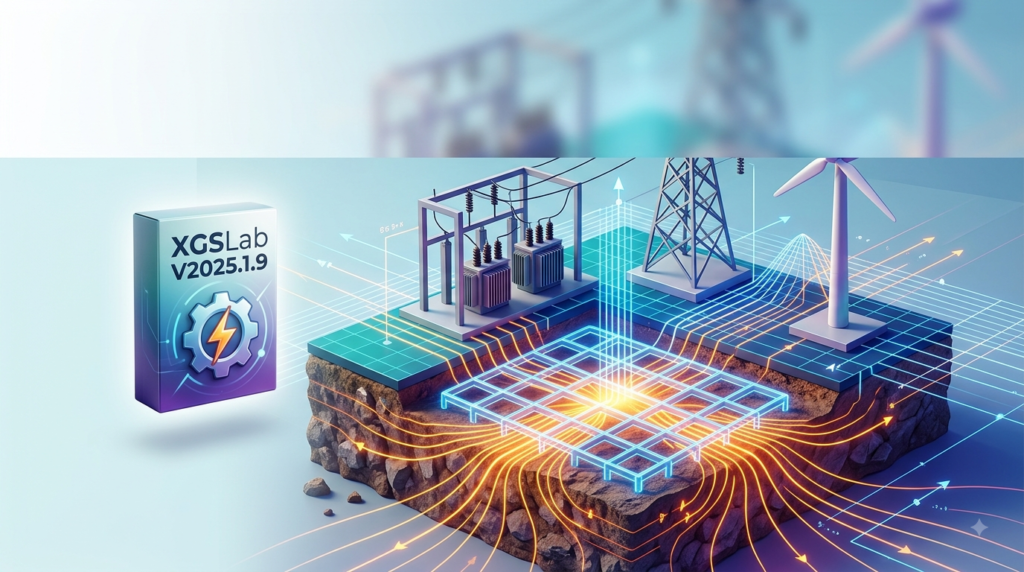


Overview of the Software
Table of Contents
XGSLab, which stands for eXtended Grounding Software Laboratory, is a professional-grade software suite designed for the electromagnetic simulation of power systems, grounding, interference, and lightning analysis . Developed by SINT Srl and now distributed globally, including as an official Bentley Systems application, XGSLab is a cornerstone tool for electrical engineers worldwide .
The XGSLab software utilizes advanced algorithms based on electromagnetic field theory, specifically Maxwell’s equations and Sommerfeld integrals, to provide precise and efficient analysis for complex engineering challenges . Its intuitive interface makes it accessible for beginners while offering the depth required by expert users in the industry. Trusted by leading universities, utilities, and top-tier electrical engineering firms, XGSLab stands as a leader in its field.
Key Features
XGSLab is packed with powerful features designed to streamline the analysis of electromagnetic phenomena. Its modular structure allows engineers to select the tools they need for specific projects.
Core Modules and Analysis Capabilities
The XGSLab software suite comprises six primary analysis modules, integrating into a single, powerful package .
-
GSA (Grounding System Analysis): The foundational module for designing and analyzing grounding systems. It includes tools for soil resistivity analysis (SRA), seasonal soil analysis (SSA), and conductor sizing. This module calculates critical safety parameters like grid resistance, touch and step voltages, and provides automated reporting .
-
GSA_FD (Frequency Domain Grounding System Analysis): An advanced module that builds on GSA by computing frequency-dependent self and mutual impedances of conductors. It uses the full-wave PEEC (Partial Element Equivalent Circuit) numerical model to handle complex grounding systems in large power facilities and substations, ensuring compliance with IEEE and other international standards .
-
XGSA_FD (Frequency Domain System Analysis): This module is designed for comprehensive electromagnetic interference (EMI) and electromagnetic field (EMF) analysis. It can model complex infrastructure projects, evaluating capacitive, inductive, and conductive interference on pipelines, railroads, and communication cables in shared corridors, all based on the full-wave PEEC model .
-
XGSA_TD (Time Domain System Analysis): Essential for analyzing transient events such as lightning strikes, switching surges, and faults in Gas Insulated Substations (GIS). By utilizing the Inverse Fast Fourier Transform (IFFT), this module provides critical insights into transient behavior, covering frequencies from DC up to about 100 MHz .
-
NETS (Network Solver): A specialized module for detailed fault current distribution calculations. Unlike standard methods, NETS uses the phase components method and graph theory to provide highly accurate, assumption-free results for current division, surpassing the capabilities of traditional sequence component methods .
-
SHIELD/SHIELD_A (Lightning Shielding Analysis): These modules are based on a complete 3D geometric model. They allow engineers to design lightning protection systems using the most widely accepted methods, such as the Rolling Sphere and Eriksson methods, ensuring the safety of infrastructure against direct lightning strikes .
Technical Specifications and Data Management
XGSLab excels in its technical capabilities and data integration.
-
Wide Frequency Range: Applicable from DC to about 100 MHz, covering all power system frequencies and the significant spectrum of electromagnetic transients .
-
Advanced Soil Modeling: Supports uniform, multilayer, and multi-zone soil models, which are critical for accurately predicting grounding system performance .
-
Parallel Computing: Leverages parallel computation and advanced mathematical libraries for fast and efficient processing of complex models .
-
Open and Interoperable Workflows: Data can be imported from and exported to AutoCAD® (DXF/DWG) . Numerical outputs are readable by MATLAB®, Microsoft EXCEL®, and Google Earth® (KML/KMZ) . Frequency-dependent impedances can be exported to EMTP® or ATP® for dynamic behavior studies .
What’s New in the Latest Version
The XGSLab V2025.1.9 release focuses on refining the user experience, enhancing computational efficiency, and updating compliance with the latest international standards. Key improvements include:
-
Enhanced Solver Performance: Optimizations to the RAM Saving threshold further improve the efficiency of large-scale simulations, particularly for complex models with tens of thousands of elements .
-
Extended Compliance: Continuous updates to ensure full compliance with the latest editions of international standards, including IEC/TS 60479-1, EN 50522, and IEEE Std 80 for touch and step voltage limits, and IEC 62305-3 and IEEE Std 998 for lightning shielding .
-
Streamlined Workflows: Further integration across the XGSLab suite provides a more seamless all-in-one package for engineers, reducing the learning curve and increasing productivity for both novice and experienced users .
System Requirements
Supported Operating Systems
XGSLab is a robust Windows-based application. To ensure optimal performance, your system should meet the following requirements.
| Component | Requirement |
|---|---|
| Operating System | Windows 10, Windows 11, or Windows Server (64-bit) |
| Processor | Multicore processor (Intel Xeon or Core i7/i9 recommended) |
| RAM | 16 GB minimum, 64 GB or more recommended for large models |
| Graphics | OpenGL compatible graphics card |
| Storage | 10 GB of free disk space for installation and project files |
Protection Keys
XGSLab uses a protection key for licensing. This can be a software-based key sent via email or a hardware key delivered by courier, with delivery times ranging from 1 to 4 working days .
Installation Guide
The software is delivered electronically. The installation process is straightforward and can be summarized as follows:
-
Obtain Credentials: After purchase, you will receive a welcome email containing your download credentials and installation instructions .
-
Download the Software: Use the provided credentials to download the XGSLab installer from the XGSLab helpdesk website .
-
Run the Installer: Execute the downloaded file and follow the on-screen instructions to install the software on your machine.
-
Activate License: Upon launching the software, you will be prompted to activate your license. This is typically done by entering the software key sent to your email. XGSLab can be activated on a machine without an internet connection .
How to Use the Software
XGSLab’s workflow is designed to be intuitive for both beginners and experts. Here’s a basic guide to getting started.
Basic Workflow for Grounding System Analysis
The general workflow for a grounding system study follows a logical sequence:
-
Define the Soil Model: Start by using the SRA (Soil Resistivity Analysis) tool to input Wenner or Schlumberger measurement data. This data is used to define the multilayer soil model, which is fundamental to the accuracy of your analysis .
-
Create the Grid Layout: You can build your grounding grid by manually inputting conductor coordinates or by importing a layout directly from a DXF or DWG file from AutoCAD .
-
Assign Material Properties: Specify the material properties for each conductor, such as radius, resistivity, and type (solid, hollow, stranded, coated, or bare) .
-
Run the Analysis: Launch the appropriate solver (e.g., GSA or GSA_FD) to calculate key parameters like grid resistance, touch and step voltages, and fault current distribution.
-
Review and Report: Generate a professional, automated report for compliance documentation and design refinement. Visualize results directly within the software or export them to a format like Google Earth for clear presentation .
Best Use Cases
XGSLab is a versatile software suite suitable for a wide range of engineering applications.
-
Substation Grounding Design: The core application of XGSLab. It is used to design safe and compliant grounding systems for power substations, ensuring personnel safety by limiting touch and step voltages during fault conditions .
-
Transmission Line Analysis: Accurately model the grounding of transmission towers and calculate the fault current distribution along overhead lines and cable networks. The NETS module is particularly useful for this purpose .
-
Electromagnetic Interference (EMI) Studies: XGSA_FD is critical for analyzing the impact of high-voltage power lines on nearby pipelines, railways, and communication cables, ensuring safe co-existence of shared infrastructure corridors .
-
Lightning Protection Systems: Use the SHIELD modules to design and validate lightning shielding systems for power plants, substations, and other critical facilities, offering a cost-effective way to reduce the risk of damage from direct strikes.
Advantages and Limitations
Pros
-
Industry Standard: Widely recognized and validated against field measurements and analytical cases since 1990 .
-
Global Compliance: Uniquely considers International (IEC), USA (IEEE), and European (EN) standards, making it suitable for projects worldwide .
-
Powerful and Flexible: Based on the robust PEEC method, enabling accurate simulation of complex scenarios across a wide frequency range .
-
Open Ecosystem: Excellent interoperability with other tools like AutoCAD, MATLAB, and Google Earth, fitting seamlessly into existing engineering workflows .
-
User-Friendly: An intuitive interface that is easy to learn for beginners and efficient for expert users .
Cons
-
Cost: Professional-grade software comes with a significant licensing cost.
-
Computational Load: Complex, full-wave models can be computationally intensive and require a powerful workstation with substantial RAM, especially for models with more than 10,000 elements when using the single-step solver .
Alternatives to the Software
While XGSLab is a market leader, several other software tools are used for grounding and electromagnetic analysis.
| Software | Type | Description | Primary Applications |
|---|---|---|---|
| XGSLab V2025.1.9 | Commercial | The definitive all-in-one solution for grounding, EMI, and lightning analysis. Fully compliant with international standards. | Power system grounding, EMF/EMI studies, lightning protection. |
| CDEGS | Commercial | A widely used suite for grounding, electromagnetic fields, and interference analysis. A long-established competitor to XGSLab. | Power system grounding, AC interference, soil structure analysis. |
| ERMES 20.0 | Open-Source | A finite element method (FEM) tool for solving Maxwell’s equations in the frequency domain . | Academic research, computational electromagnetics. |
| Groundinsight | Open-Source | A Python library developed for the calculation and analysis of earthing systems. Validated for analyzing fault currents . | Academic research, custom analysis and automation of earthing studies. |
Frequently Asked Questions
What is XGSLab used for?
XGSLab is a specialized software used by electrical engineers for electromagnetic simulation of power systems, grounding system analysis, and electromagnetic interference (EMI) studies. It is a primary tool for designing safe and compliant substation grounding and assessing lightning risks.
How much does XGSLab cost?
XGSLab is a commercial product and the price varies depending on the selected modules and licensing type (e.g., GSA Standard, GSA_FD Professional, or the full suite). The official website offers a free trial so you can evaluate the software before purchase.
What is the PEEC method in XGSLab?
The PEEC (Partial Element Equivalent Circuit) method is the core numerical model in XGSLab. It is a full-wave method that solves Maxwell’s equations, allowing for accurate electromagnetic simulations over a wide frequency range (DC to 100 MHz) for arbitrarily shaped and sized conductor configurations .
How do I get a free trial of XGSLab?
You can request a free trial by filling out a form on the official XGSLab page on the Bentley Systems website. A representative will contact you to review your needs and confirm your eligibility . EasyPower, the exclusive North American reseller, also offers free trials for users in the US and Canada .
Can XGSLab import CAD files?
Yes, one of XGSLab’s strengths is its data interoperability. It can directly import layout data from DXF or DWG files, allowing you to work within a familiar CAD environment.
Does XGSLab support multilayer soil models?
Yes, XGSLab supports a powerful and rigorous multilayer soil model with an arbitrary number of layers, which is crucial for accurate grounding system performance analysis.
Final Thoughts
XGSLab V2025.1.9 stands out as a premier engineering software for grounding and electromagnetic analysis, combining a powerful, scientifically validated simulation engine with a user-friendly interface and extensive industry compliance. Its robust PEEC-based solvers and comprehensive module suite (GSA, XGSA_FD, XGSA_TD, NETS, SHIELD) make it an indispensable tool for electrical engineers tasked with designing safe and compliant power infrastructure. Whether you are designing a new substation or analyzing complex EMI issues, XGSLab provides the accuracy and reliability needed for critical engineering projects. To see its full potential, requesting the free trial is a recommended first step.
Our Paid Service