
Overview of SES CDEGS Suite
Table of Contents
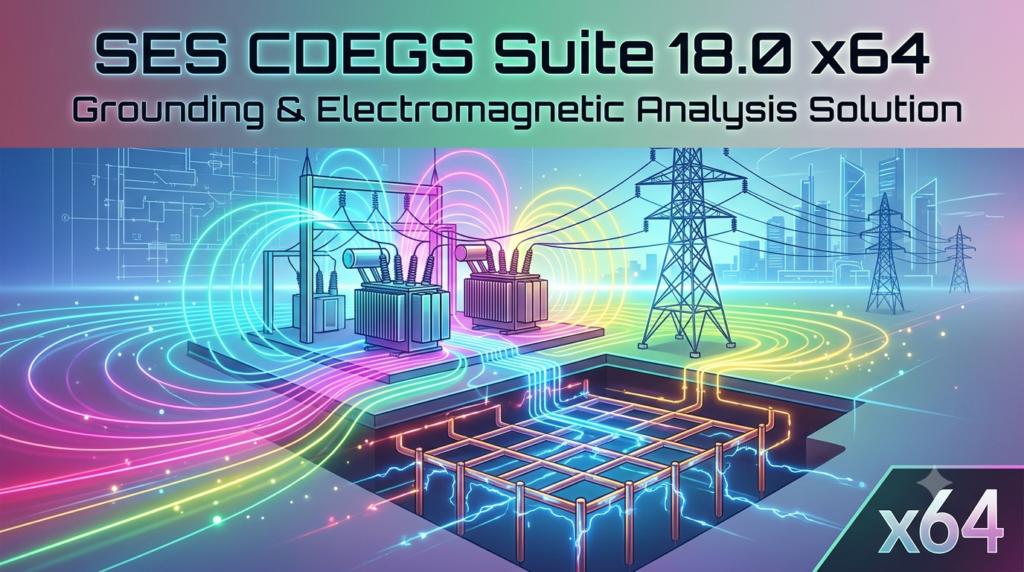
SES CDEGS Suite (Current Distribution, Electromagnetic Fields, Grounding, and Soil Structure Analysis) is a professional-grade engineering software package designed for analyzing grounding systems, electromagnetic interference, and soil resistivity. Developed by Safe Engineering Services & Technologies, CDEGS 18.0 x64 represents the latest 64-bit version of this industry-standard solution for power system engineers, electrical consultants, and grounding system designers worldwide.
The software suite provides advanced computational tools for simulating complex electrical phenomena, including fault current distribution, electromagnetic field behavior, and grounding system performance. Engineers and researchers rely on SES CDEGS to design safe and reliable electrical infrastructure for power plants, substations, transmission lines, renewable energy installations, and industrial facilities.
This 64-bit version delivers enhanced processing power, allowing users to handle larger datasets and more complex models than previous releases. The CDEGS Suite integrates multiple modules that address different aspects of electrical system analysis, making it a versatile platform for comprehensive electromagnetic studies.
Key Features
Soil Resistivity Analysis and Modeling
SES CDEGS Suite 18.0 includes sophisticated soil characterization capabilities. The software processes field measurements from Wenner, Schlumberger, and other resistivity testing methods to create accurate soil models. Users can define multi-layer soil structures with varying resistivities and thicknesses, essential for predicting grounding system performance under different conditions.
Grounding System Design and Analysis
The grounding module enables detailed modeling of complex grounding grids, including buried conductors, ground rods, and interconnected systems. Engineers can analyze step and touch voltages, ground potential rise (GPR), and fault current distribution under various fault scenarios. The software computes safety parameters according to international standards such as IEEE 80, IEC 60364, and other regional regulations.
Electromagnetic Field Computation
The suite provides robust electromagnetic field analysis tools for both low and high-frequency applications. Users can calculate magnetic and electric fields generated by transmission lines, cables, and substation equipment. The software supports frequency-domain and time-domain simulations, making it suitable for power quality studies and EMC compliance assessments.
Fault Current Distribution Analysis
The CDEGS Suite models current distribution in complex power networks during fault conditions. The software accounts for conductor impedances, grounding system characteristics, and soil properties to determine how fault currents flow through grounding grids, neutral conductors, and other paths. This analysis helps engineers optimize protective device settings and ensure personnel safety.
Lightning Protection Studies
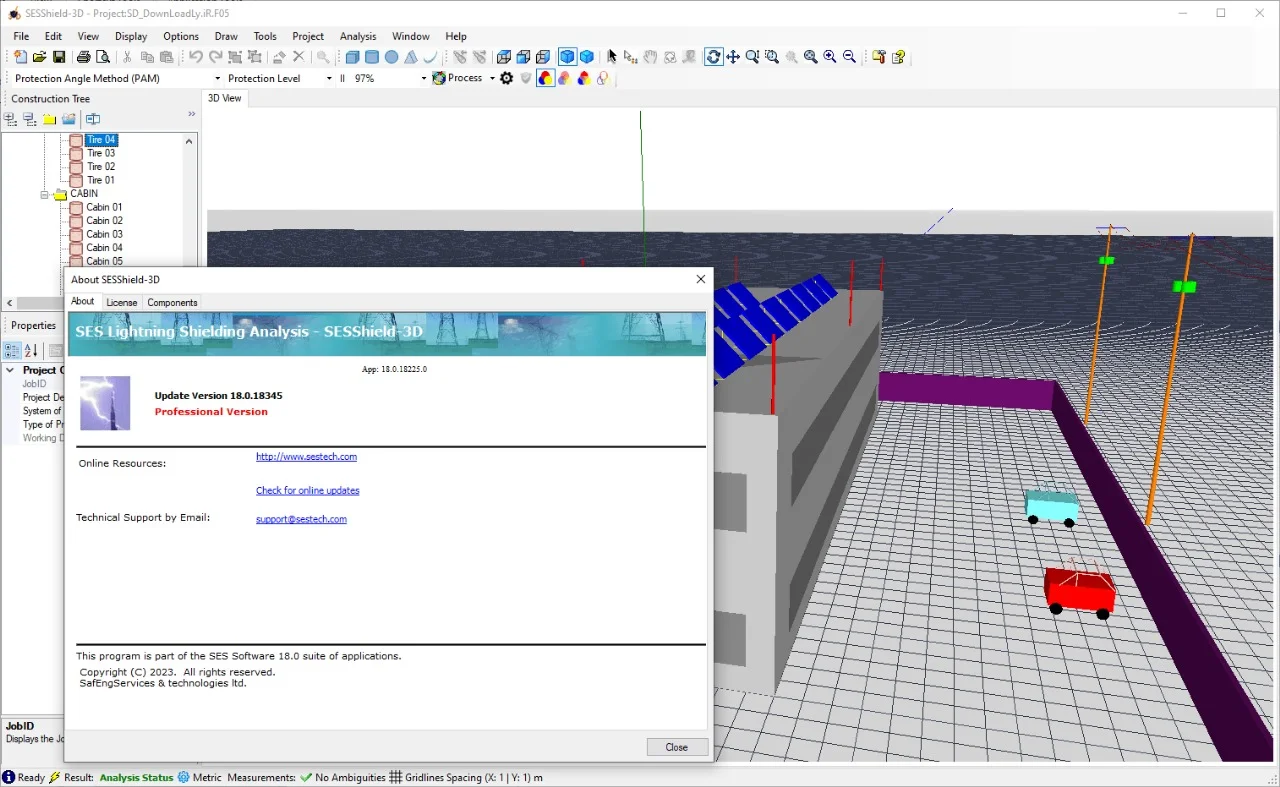
Engineers can evaluate lightning protection system effectiveness using the CDEGS transient analysis capabilities. The software simulates lightning strike impacts on electrical infrastructure, assessing surge propagation, voltage stresses, and equipment protection requirements. This feature is particularly valuable for critical infrastructure projects and high-risk installations.
Pipeline and Rail Corridor Analysis
The software includes specialized tools for evaluating electromagnetic interference on pipelines, railways, and other linear infrastructure. Engineers can model AC interference from transmission lines, calculate induced voltages, and design mitigation measures to protect metallic structures from corrosion and safety hazards.
Advanced Visualization and Reporting
The 64-bit architecture supports high-resolution 3D visualization of electrical fields, potential gradients, and current distributions. Users can generate professional reports with customizable plots, tables, and graphical outputs suitable for regulatory submissions and stakeholder communication.
What’s New in SES CDEGS Suite 18.0
Enhanced Processing Performance
The 64-bit version delivers significant performance improvements for large-scale simulations. Users can model larger grounding grids with thousands of conductors and process complex soil models without memory limitations. Computation times are reduced through optimized algorithms and parallel processing capabilities.
Updated Standards Compliance
SES CDEGS 18.0 incorporates the latest revisions of international standards, ensuring designs comply with current safety regulations. The software supports IEEE 80-2022 requirements and includes updated safety criteria for step and touch voltage calculations.
Improved User Interface
The software features a refreshed interface with improved navigation and workflow management. New toolbar designs and menu structures streamline common tasks, reducing the learning curve for new users while maintaining efficiency for experienced professionals.
Enhanced Soil Model Capabilities
Version 18.0 introduces advanced soil modeling options, including temperature-dependent resistivity and frequency-dependent soil parameters. These improvements enable more accurate predictions of grounding performance under varying environmental conditions.
Expanded Frequency Analysis Range
The latest release supports a broader frequency spectrum for electromagnetic calculations, extending the software’s applicability to high-frequency effects in power systems. This enhancement is particularly beneficial for studies involving harmonics, transients, and electromagnetic compatibility.
System Requirements
Operating Systems
The CDEGS Suite 18.0 x64 runs on 64-bit versions of:
-
Windows 10 Professional or Enterprise
-
Windows 11 Professional or Enterprise
-
Windows Server 2019 and 2022
-
Virtualized environments running supported Windows versions
Hardware Specifications
| Component | Minimum Requirement | Recommended Configuration |
|---|---|---|
| Processor | Intel Core i5 or AMD equivalent | Intel Xeon or AMD Ryzen with 8+ cores |
| RAM | 16 GB | 32 GB or more |
| Storage | 500 GB SSD | 1 TB NVMe SSD |
| Graphics | Integrated graphics with 2 GB | Dedicated GPU with 8 GB VRAM |
| Display | 1920 x 1080 resolution | Dual 4K monitors |
| Network | 100 Mbps Ethernet | 1 Gbps Ethernet |
Additional Requirements
-
USB port for hardware security key
-
Internet connection for license validation
-
Microsoft .NET Framework 4.8 or later
-
Microsoft Excel 2016 or later for data export functionality
Installation Guide for SES CDEGS Suite 18.0
Pre-Installation Preparation
Before installing SES CDEGS 18.0 x64, follow these essential steps to ensure a successful installation:
-
System Verification: Confirm your system meets the minimum hardware requirements for the 64-bit version.
-
Administrative Access: Ensure you have administrator privileges on the target machine.
-
License Key Preparation: Locate your hardware security key or network license server details.
-
Data Backup: Back up any existing project files from previous CDEGS installations.
-
Disable Security Software: Temporarily disable antivirus and firewall applications that might interfere with installation.
Installation Steps
-
Download Installation Package: Obtain the official SES CDEGS 18.0 x64 installation files from the authorized distribution source.
-
Run Setup: Execute the installer with administrator privileges by right-clicking and selecting “Run as administrator.”
-
Select Installation Type: Choose between typical installation (recommended) or custom installation for advanced users.
-
Configure Installation Directory: Select the installation directory or accept the default location.
-
Module Selection: Choose the required CDEGS modules for your application. Include modules such as:
-
RESAP for soil resistivity analysis
-
MALT for grounding system analysis
-
HIFREQ for electromagnetic field calculations
-
TRALIN for transmission line modeling
-
SPITS for transient analysis
-
-
License Configuration: Enter license server information or connect the hardware security key.
-
Complete Installation: Follow the on-screen prompts to finish the installation process.
-
Restart System: Reboot your computer to finalize system configurations.
-
Software Activation: Launch CDEGS and complete the activation process according to your license agreement.
Post-Installation Verification
After installation, verify the software operation by:
-
Opening sample projects included with the installation
-
Running a simple soil resistivity calculation
-
Creating a basic grounding system model
-
Generating a test report to confirm plotting functionality
How to Use SES CDEGS Suite
Project Setup and Configuration
Begin your analysis by creating a new project and configuring the basic parameters:
-
Define Units and Standards: Select appropriate measurement units and design standards for your region.
-
Set Soil Parameters: Input soil resistivity data from field measurements or soil surveys.
-
Configure Frequency Settings: Establish the frequency range for electromagnetic calculations.
-
Specify Conductor Properties: Define materials, dimensions, and electrical properties for system conductors.
Module-Specific Workflows
RESAP (Soil Resistivity Analysis)
-
Import soil measurement data from field instruments
-
Process apparent resistivity values
-
Create multi-layer soil models
-
Validate models with statistical analysis
-
Export soil parameters for use in other modules
MALT (Grounding Analysis)
-
Design grounding grid geometry
-
Define conductor spacing and burial depth
-
Input soil model parameters
-
Set fault current characteristics
-
Run ground resistance and potential gradient calculations
-
Evaluate step and touch voltage safety
-
Optimize grid design for performance and cost
HIFREQ (Electromagnetic Field Analysis)
-
Define source characteristics (current, voltage)
-
Specify conductor configurations
-
Set observation points for field calculations
-
Compute electric and magnetic fields
-
Generate field distribution plots
-
Analyze environmental and safety compliance
Advanced Analysis Techniques
Parametric Studies: Use the software’s parametric analysis capabilities to evaluate design variations. Create multiple scenarios with different soil parameters, conductor arrangements, or fault conditions to identify optimal solutions.
Transient Analysis: Simulate lightning strikes and switching surges using the time-domain analysis features. Capture system response at specific time intervals to assess voltage stress and transient overvoltages.
Optimization Studies: Employ the built-in optimization algorithms to find the most cost-effective grounding grid configuration that meets safety requirements. Adjust conductor density, burial depth, and rod placement to achieve optimal results.
Results Interpretation
-
Analyze potential gradient plots for safety compliance
-
Review fault current distribution diagrams for protection coordination
-
Interpret electromagnetic field maps for environmental assessment
-
Evaluate grounding resistance values against design targets
-
Assess corrosion risk from AC interference on buried structures
Best Use Cases for SES CDEGS Suite
Substation Grounding Design
Engineers use CDEGS for designing safe and reliable grounding systems in electrical substations. The software analyzes complex grid configurations, accounts for soil stratification, and ensures compliance with safety standards for step and touch voltages. Large-scale substation projects benefit from the 64-bit version’s ability to handle extensive conductor networks and detailed soil models.
Transmission Line Electromagnetic Studies
Power utilities employ CDEGS to evaluate electromagnetic fields near transmission lines. The software assesses field strength at ground level, calculates induced voltages on nearby structures, and analyzes interference with communication systems. These studies support siting decisions and environmental impact assessments.
Renewable Energy Installation Analysis
Wind farms and solar power plants require specialized grounding analysis due to their distributed nature. CDEGS models the interconnected grounding systems across expansive sites, considering fault current distribution, lightning protection requirements, and personnel safety across diverse terrain conditions.
Industrial Facility Electrical Safety
Manufacturing facilities with high-power equipment benefit from CDEGS grounding and electromagnetic analysis. The software identifies potential hazards from fault currents and electromagnetic fields, enabling engineers to implement appropriate mitigation measures and ensure worker safety.
Cathodic Protection and Corrosion Studies
Pipeline operators use CDEGS for AC interference assessment and cathodic protection design. The software evaluates the interaction between power systems and pipelines, helping engineers implement corrosion prevention strategies and comply with industry regulations.
Advantages and Limitations
Key Advantages
Comprehensive Analysis Capabilities: The CDEGS Suite covers a wide range of applications, from simple grounding designs to complex electromagnetic interference studies, making it a complete solution for power system engineering projects.
Industry-Standard Acceptance: Being widely adopted by utilities and engineering firms ensures consistency in design methodologies and facilitates collaboration with industry partners.
Detailed Results and Visualization: The software provides detailed results with professional-quality visualizations, supporting clear communication of technical findings to stakeholders.
Scalability for Projects: The 64-bit version accommodates project size expansion without performance degradation, supporting growth from small facilities to large infrastructure projects.
Standards Compliance: Regular updates ensure alignment with international standards, reducing compliance risk in regulated industries.
Limitations
Specialized Knowledge Requirement: The software requires understanding of electrical engineering principles, particularly in grounding, power systems, and electromagnetic theory. Training is recommended for new users to fully utilize the software’s capabilities.
Computational Demands: Complex simulations, particularly transient and high-frequency analyses, require powerful computing resources for efficient processing.
Software Cost: The professional-grade capabilities come with a significant licensing cost, which can be prohibitive for smaller firms or individual engineers.
Learning Curve: The extensive feature set and engineering depth require dedicated learning time to achieve proficiency.
Alternatives to SES CDEGS Suite
XGSLab
XGSLab offers grounding and electromagnetic analysis capabilities with a focus on power system applications. The software provides soil modeling, grounding design, and electromagnetic compatibility studies. It is known for its user-friendly interface and compatibility with international standards, offering a compelling alternative for medium-sized projects.
PLS-CADD with Grounding Module
PLS-CADD includes transmission line design and grounding analysis functionality. The suite is particularly well-suited for overhead line projects and offers integrated design capabilities for line routing, structure design, and grounding analysis.
CDEGS Viewer
The CDEGS Viewer provides limited functionality for reviewing and presenting CDEGS project files without requiring a full software license. This alternative is useful for stakeholders who need to view results but do not require analysis capabilities.
WinIGS
WinIGS offers grounding system design capabilities with a focus on industrial and substation applications. The software provides the tools for modeling complex grounding systems in a more affordable package.
Comparison of Alternative Solutions
| Software | Best Application | Key Strength | Suitable Project Size |
|---|---|---|---|
| XGSLab | Substation and industrial | User-friendly interface | Small to medium |
| PLS-CADD | Transmission line design | Integrated line design | Large |
| WinIGS | Industrial grounding | Cost-effective | Small to medium |
| CDEGS Suite | Comprehensive studies | Complete engineering solution | All sizes |
Frequently Asked Questions
What is SES CDEGS Suite used for?
SES CDEGS Suite is a comprehensive software package for grounding system design, electromagnetic field analysis, and soil resistivity studies. Electrical engineers use it to analyze electrical infrastructure for power plants, substations, transmission lines, industrial facilities, and renewable energy installations. The software helps ensure safety compliance and optimize system performance.
Is SES CDEGS Suite compatible with Windows 11?
Yes, SES CDEGS Suite 18.0 x64 supports Windows 11 Professional and Enterprise editions. The software requires a 64-bit Windows operating system and benefits from Windows 11’s enhanced security and performance features. Always verify compatibility with the latest service pack before installation.
What are the system requirements for SES CDEGS 18.0 x64?
The minimum requirements include a 64-bit processor, 16 GB of RAM, 500 GB SSD storage, and a graphics card with 2 GB VRAM. Professional use recommends 32 GB RAM, an 8-core processor, and dedicated graphics hardware. Ensure you have the required Microsoft .NET Framework and administrative privileges for installation.
How does SES CDEGS 18.0 x64 compare to previous versions?
The 18.0 x64 version offers improved performance through 64-bit architecture, allowing larger and more complex models. New features include updated standards compliance, enhanced soil characterization capabilities, expanded frequency analysis range, and a modernized user interface. The software processes simulations faster and supports larger datasets than earlier versions.
What modules are included in SES CDEGS Suite?
The suite includes various modules for different applications: RESAP for soil resistivity analysis, MALT for grounding system design, HIFREQ for electromagnetic field calculations, TRALIN for transmission line modeling, SPITS for transient analysis, and additional modules for AC interference studies, cathodic protection analysis, and power quality assessment.
Is training required for SES CDEGS Suite?
While not mandatory, training is highly recommended due to the software’s engineering complexity and extensive feature set. Professional training courses are available through SES and authorized partners. New users should also consider starting with the documentation and tutorials to understand basic workflows before attempting complex analyses.
What are the best alternatives to SES CDEGS?
Alternatives include XGSLab for user-friendly grounding analysis, PLS-CADD for integrated transmission line design, and WinIGS for cost-effective industrial grounding solutions. The choice depends on specific project requirements, budget constraints, and application scope.
Can SES CDEGS be used for renewable energy projects?
Yes, the software is well-suited for renewable energy installations, including wind farms and solar power plants. It supports modeling of distributed grounding systems and assists in evaluating lightning protection and personnel safety for large-scale renewable energy infrastructure.
What license options are available for SES CDEGS?
SES offers various licensing options including permanent, annual, and network licenses. The specific license structure can include different combinations of modules based on the user’s requirements. Contact SES or their authorized distributors for current pricing and licensing details.
Does SES CDEGS support international standards?
Yes, the software supports multiple international standards including IEEE 80, IEC 60364, and various regional grounding regulations. The software is updated to incorporate the latest standard revisions, ensuring designs comply with current safety requirements.
Final Thoughts
SES CDEGS Suite 18.0 x64 represents the cutting edge in grounding system design and electromagnetic analysis software. The 64-bit architecture has significantly improved the software’s capabilities, enabling engineers to tackle larger and more complex projects with confidence. For power system engineers, electrical consultants, and infrastructure designers, CDEGS offers a comprehensive solution that addresses the full spectrum of electromagnetic studies required in modern electrical engineering practice.
The software’s strength lies in its ability to provide accurate, standards-compliant results while maintaining professional-grade visualization and reporting capabilities. While it requires specialized knowledge and represents a significant investment, the CDEGS Suite remains an essential tool for organizations that require reliable, industry-recognized analysis of grounding and electromagnetic phenomena.
For those considering the software, it is important to assess your project requirements, computing resources, and available training support before making a commitment. The benefits of improved design safety, regulatory compliance, and optimized infrastructure performance make SES CDEGS a compelling solution for engineering organizations dedicated to excellence in electrical system design.
As the power industry continues to evolve with renewable energy integration, smart grid development, and stricter safety regulations, the demand for sophisticated electromagnetic analysis tools will likely grow. SES CDEGS Suite positions itself well to meet these emerging challenges, providing a platform that supports both current engineering needs and future technological developments.
Our Paid Service
“We do not sell or provide any software. We only offer professional support services. If any software on your system is not working properly, or you are facing installation errors, crashes, or any other technical issue — just contact us. We will help you fix the problem quickly and remotely via AnyDesk. No software will be provided from our side — only expert troubleshooting and support.”