
Overview of AVEVA Dynamic Simulation
Table of Contents
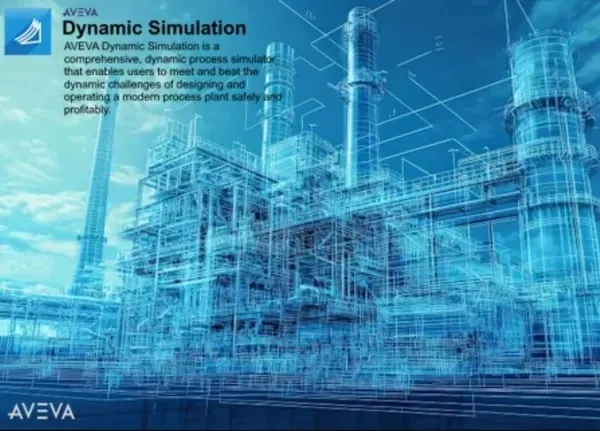
AVEVA Dynamic Simulation, formerly known as DYNSIM, is a comprehensive dynamic process simulator designed for engineering design, control system validation, and operator training in the process and power industries . This high-fidelity simulation software uses rigorous, first-principles dynamic modeling to help organizations meet the dynamic challenges of designing, commissioning, controlling, and operating modern process plants safely and profitably .
The software enables users to simulate time-dependent behaviors across gas, liquid, multiphase, and non-ideal systems. Unlike steady-state tools, AVEVA Dynamic Simulation models process dynamics over time, capturing transient events such as startup and shutdown, pressure surges, valve switching, and process upsets .
AVEVA Dynamic Simulation 2026.0 is available via cloud deployment through AVEVA Connect or through traditional on-premise access, with runtime licensing options for operator training simulators .
Key Features
First-Principles Dynamic Modeling
The simulation engine uses rigorous, physics-based modeling of fluids, heat, pressure, and mass transfer. This approach delivers highly accurate predictions across complex process systems including gas, liquid, multiphase, and non-ideal systems .
Transient Process Simulation
The software simulates critical time-dependent behaviors including:
-
Startup and shutdown procedures
-
Pressure surge analysis
-
Valve switching dynamics
-
Heat exchanger fouling effects
-
Control system response
-
Emergency scenarios and process upsets
Control System Validation and Logic Testing
AVEVA Dynamic Simulation provides comprehensive control system testing capabilities:
-
Interface with DCS and PLC emulators
-
Validate control logic, interlocks, alarms, and shutdown sequences
-
Verify PID tuning and advanced process control schemes
-
Perform Integrated Factory Acceptance Tests (iFAT)
-
Detect logic errors early to reduce commissioning risk
Scalable Model Libraries
The software includes an extensive equipment library featuring compressors, pumps, reactors, distillation columns, furnaces, and heat exchangers. Custom unit modeling is also supported for specialized processes .
Flexible Deployment Options
AVEVA Dynamic Simulation 2026.0 supports both cloud and on-premises deployment:
-
Secure user access control
-
Seamless maintenance and IT overhead reduction
-
Runtime licensing for training or long-term simulation
-
Cloud access via AVEVA Connect
Integration with AI and Autonomous Operations
A notable advancement in recent versions is the integration with the NVIDIA Raptor deep reinforcement learning engine. This combination enables the development of AI-driven control policies for autonomous plant operations . Organizations can train DRL agents to stabilize processes faster than manual operators, optimizing production and reducing unplanned downtime .
Instructor and Training Features
The operator training simulator (OTS) includes robust instructor capabilities:
-
Administrator, engineer, instructor, and operator access modes
-
Scenario creation and management
-
Trend and profile plotting
-
Trainee performance monitoring
-
Built-in model malfunctions and control cross-referencing
-
Snapshot functionality for initial conditions and backtracks
Seamless Connectivity
AVEVA Dynamic Simulation integrates with various systems and tools:
-
Microsoft Excel connectivity
-
OPC integration
-
AVEVA PRO/II Simulation Translator
-
AVEVA Simulation for Foxboro Controls and Triconex Systems
-
Major third-party control systems
-
SPT OLGA integration
What’s New in AVEVA Dynamic Simulation 2026.0
Enhanced AI Capabilities
The 2026.0 version builds on the integration with NVIDIA Raptor, offering improved capabilities for training AI agents. This enables accelerated development of autonomous control systems that can handle complex transient conditions such as changing feed levels, startups, and unplanned disruptions .
Cloud-Native Deployment
AVEVA Dynamic Simulation 2026.0 further refines its cloud deployment options through AVEVA Connect, allowing for:
-
Reduced IT infrastructure requirements
-
Simplified access and maintenance
-
Scalable deployment across organizations
-
Real-time collaboration capabilities
Improved Control System Integration
Enhanced connectivity with Distributed Control Systems (DCS) and Programmable Logic Controllers (PLC) provides more seamless integration for virtual commissioning and control system validation .
System Requirements
Client System Requirements
AVEVA Dynamic Simulation 2026.0 is delivered through application streaming technology for cloud deployments, minimizing client hardware requirements :
Operating System: Windows 10 (64-bit) or later, Windows Server 2016 or later
Supported Browsers: Any modern browser (Internet Explorer and Safari are not supported)
Network Requirements
For optimal cloud-based performance:
-
Minimum Bandwidth: 16 Mbps
-
Recommended Bandwidth: 21-50 Mbps for good performance; >50 Mbps for very good performance
-
Latency: <150 ms to Azure datacenter; <50 ms is rated very good
White-list Requirements
-
*.chp.connect.aveva.com -
Web sockets must be enabled
On-Premise Deployment Requirements
For on-premise installations, hardware specifications depend on model complexity and number of concurrent users. Industrial process simulators of this scale typically require:
-
Multi-core processors with high clock speeds
-
8-32 GB RAM for moderate to large models
-
Sufficient storage for project files and historical data
Installation Guide
Cloud Deployment through AVEVA Connect
-
Access AVEVA Connect: Navigate to the AVEVA Connect portal and log in with your credentials
-
Select the Simulation Service: Choose AVEVA Simulation from available services
-
Launch the Application: The application streams to your browser with no local installation required
-
Verify Network Connectivity: Ensure your network meets bandwidth and latency requirements
On-Premise Installation
-
Verify System Requirements: Confirm hardware and operating system compatibility
-
Obtain License File: Secure the appropriate license from AVEVA
-
Run the Installer: Execute the installation package and follow on-screen prompts
-
Configure License Server: Set up license management according to organizational requirements
-
Complete Setup: Finalize configuration and test connectivity
How to Use AVEVA Dynamic Simulation
Building a Simulation Model
-
Create a New Flowsheet: Start with the graphical user interface to build process flow diagrams
-
Select Unit Operations: Drag and drop equipment from the model library
-
Define Feed Streams: Specify composition, temperature, pressure, and flow rates
-
Connect Units: Establish material and energy flow paths between equipment
-
Configure Parameters: Set equipment specifications and operating conditions
Running a Dynamic Simulation
-
Initialize the Model: Set initial conditions for all process variables
-
Run the Simulation: Execute the dynamic simulation at desired speed (real-time, faster, or slower)
-
Monitor Key Variables: Use trends and profile plots to observe process behavior
-
Apply Disturbances: Introduce changes to test process response
-
Take Snapshots: Save simulation states for later use or backtracking
Using the Operator Training Simulator
-
Access Instructor Mode: Log in with instructor credentials
-
Load or Create Scenarios: Set up training exercises
-
Configure Malfunctions: Insert equipment or control failures for training
-
Monitor Trainees: Track operator responses and decisions
-
Review Performance: Use the data historian to analyze trainee actions
Best Use Cases
Engineering Design and Process Optimization
AVEVA Dynamic Simulation helps engineers validate process designs before capital investment. By simulating transient conditions, teams can identify issues in sizing, control strategies, and safety systems early in the design phase .
Control System Checkout and Validation
The software enables virtual commissioning of DCS and PLC systems, significantly reducing on-site startup time. Engineering teams can validate control logic, alarm strategies, and shutdown sequences before plant construction .
Operator Training Simulators (OTS)
AVEVA Dynamic Simulation serves as a high-fidelity training environment for plant operators. Trainees can practice startup, shutdown, and emergency response in a safe, risk-free setting .
Digital Twin Implementation
The simulation models serve as the foundation for digital twin applications throughout the asset lifecycle. Organizations like ACCIONA have deployed AVEVA Dynamic Simulation for desalination plant digital twins, combining real-time data with dynamic modeling for scenario testing and predictive maintenance .
AI and Autonomous Control Development
Recent innovations enable integration with reinforcement learning platforms like NVIDIA Raptor to train AI agents for autonomous process control. This is particularly valuable for:
-
Distillation system optimization
-
Batch process control
-
Complex startup and shutdown procedures
Power Generation Applications
AVEVA offers specialized simulation capabilities for power generation:
-
Conventional boiler units (gas, oil, coal, biomass)
-
Once-through supercritical units
-
Combined cycle gas turbine plants
-
Integrated Gasification Combined Cycle (IGCC) facilities
Advantages and Limitations
Advantages
Comprehensive Dynamic Modeling: First-principles approach delivers high accuracy across a wide range of process conditions and systems
End-to-End Lifecycle Support: Models scale from engineering design through operator training and plant operations within a unified environment
Control System Integration: Robust connectivity with DCS and PLC systems enables virtual commissioning and control validation
Flexible Deployment: Cloud and on-premise options accommodate different organizational requirements
AI-Ready Platform: Integration with reinforcement learning supports autonomous operations development
Proven Industry Track Record: Over 1,200 implementations across oil and gas, petrochemicals, refining, chemicals, power, and food industries
Limitations
Specialized Expertise Required: Effective use requires training in process modeling and simulation, typically suited for chemical process engineers and specialist simulation teams
Cost Considerations: Comprehensive dynamic simulation solutions represent significant investment, typically $20,000-$30,000 USD annually for single steady-state access
Hardware Requirements for Complex Models: Large, detailed models may require high-performance computing resources for optimal performance
Learning Curve: Advanced features, particularly in control system integration and instructor functions, require dedicated training time
Alternatives to AVEVA Dynamic Simulation
Aspen HYSYS
A market-leading process simulation tool with robust dynamic modeling capabilities. HYSYS is widely used in the oil and gas industry and offers extensive thermodynamic property packages and integration with other AspenTech products .
Honeywell UniSim Design
Derived from HYSYS, UniSim offers strong dynamic simulation capabilities optimized for operator training and control system validation. It is particularly well-suited for training simulators and dynamic studies in energy and chemical processing .
gPROMS
gPROMS specializes in modeling inherently dynamic processes like pressure swing adsorption and temperature swing adsorption. It offers unique capabilities in detailed dynamic optimization and is strong in supporting R&D applications .
AVEVA PRO/II
The steady-state counterpart to AVEVA Dynamic Simulation, PRO/II offers intuitive and natural simulation capabilities for oil and gas processing. Unlike Dynamic Simulation, PRO/II focuses on steady-state design rather than transient analysis .
KBC PetroSIM
Specialized in refinery modeling, PetroSIM is strong in reactor models and utility simulation. It offers dynamic modules and is widely used in oil refining and petrochemicals .
ProMax
ProMax started with specialized capabilities for amine and sulfur recovery but has expanded its dynamic modeling capabilities. It is considered one of the most aggressively developed simulators in terms of new features .
Comparison Summary
| Feature | AVEVA Dynamic Simulation | Aspen HYSYS | Honeywell UniSim | gPROMS |
|---|---|---|---|---|
| First-Principles Modeling | ✓ | ✓ | ✓ | ✓ |
| Operator Training Simulator | ✓ | ✓ | ✓ | Limited |
| AI Integration | ✓ (NVIDIA Raptor) | Limited | Limited | Limited |
| Control System Validation | ✓ | ✓ | ✓ | ✓ |
| Steady-State Mode | Limited | ✓ | ✓ | Limited |
| Specialized Applications | Power, LNG, Refining | Upstream, Refining | OTS, Refining | R&D, Adsorption |
Frequently Asked Questions
What is AVEVA Dynamic Simulation used for?
AVEVA Dynamic Simulation is a high-fidelity process simulator used for engineering design validation, control system checkout, operator training, and digital twin applications across process industries including oil and gas, chemicals, refining, and power generation .
What is the difference between AVEVA Dynamic Simulation and AVEVA PRO/II?
AVEVA Dynamic Simulation focuses on time-dependent, transient process behavior for dynamic studies, control system validation, and operator training. AVEVA PRO/II is primarily a steady-state simulator for process design and engineering studies .
What are the system requirements for AVEVA Dynamic Simulation 2026.0?
For cloud deployment through AVEVA Connect, the requirements are minimal: any modern browser (excluding Internet Explorer and Safari) with network bandwidth of at least 16 Mbps and latency below 150 ms to Azure data centers. For on-premise deployment, hardware requirements depend on model complexity and user count .
How does AVEVA Dynamic Simulation support digital twins?
AVEVA Dynamic Simulation provides the dynamic modeling foundation for digital twin applications. These digital twins combine real-time operational data with simulation models to enable scenario testing, predictive maintenance, performance optimization, and operator training across the asset lifecycle .
What industries use AVEVA Dynamic Simulation?
The software is deployed across a wide range of industries including oil and gas exploration and production, refining, petrochemicals, power generation (conventional and renewable), chemicals, and water treatment. Over 1,200 successful implementations exist globally .
Can AVEVA Dynamic Simulation integrate with AI for autonomous control?
Yes, AVEVA Dynamic Simulation integrates with the NVIDIA Raptor deep reinforcement learning engine to train AI agents for autonomous process control. This enables the development of control policies that can stabilize processes faster than manual operators, particularly during transient events such as feed changes and process upsets .
What is the cost of AVEVA Dynamic Simulation?
Pricing for AVEVA Dynamic Simulation is not publicly listed, as it depends on deployment model, number of users, and required features. Commercial process simulation solutions typically range from $20,000 to $30,000 USD per year for single user access .
How do I access AVEVA Dynamic Simulation training?
AVEVA provides technical support and training resources through their official website and partner network. Training is essential for effective use of dynamic simulation features and instructor capabilities .
Final Thoughts
AVEVA Dynamic Simulation 2026.0 represents a sophisticated solution for organizations requiring high-fidelity process simulation across engineering design, control system validation, and operator training. Its first-principles modeling approach delivers the accuracy needed for complex process analysis, while its comprehensive feature set addresses the full plant lifecycle.
The software’s recent innovations, particularly in AI integration and cloud deployment, position it at the forefront of industrial simulation technology. Organizations investing in AVEVA Dynamic Simulation gain a platform that supports both immediate operational needs and emerging applications in autonomous process control and digital twin deployment .
For chemical engineers, process designers, and operational teams in energy-intensive industries, AVEVA Dynamic Simulation offers a robust, field-proven solution for meeting the dynamic challenges of modern process plant design and operation. While the learning curve and investment are significant, the benefits in risk reduction, operational optimization, and workforce training make it a valuable tool for organizations committed to process excellence and innovation