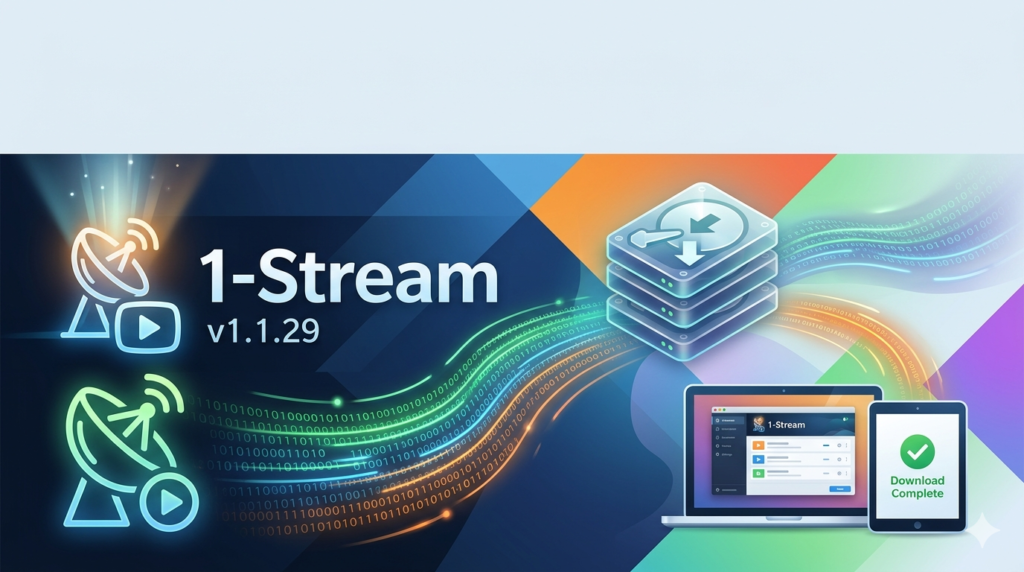


Download the 1-Stream Software v1.1.29 (The Complete Guide to Unified Business Process Integration) from this link…

Overview of 1-Stream Software
Table of Contents
In the modern digital economy, operational fragmentation remains one of the biggest barriers to growth. Businesses frequently struggle with disconnected systems where customer data, supply chain information, and financial reporting exist in separate silos. 1-Stream Software addresses this critical challenge by providing a comprehensive integration platform designed to unify diverse business processes into a single, cohesive workflow.
Unlike basic middleware solutions, 1-Stream functions as an end-to-end operational hub. It enables real-time data synchronization between Customer Relationship Management (CRM), Enterprise Resource Planning (ERP), and third-party logistics platforms. The current version, v1.1.29, introduces enhanced automation logic and reporting granularity, making it a relevant choice for small-to-medium enterprises (SMEs) looking to scale without replacing their entire tech stack.
Key Features of 1-Stream v1.1.29
The software distinguishes itself through a modular feature set. Below is an analysis of its core capabilities based on the v1.1.29 release notes.
1. Cross-Departmental Data Orchestration
-
Function: Bi-directional sync between sales, inventory, support, and finance modules.
-
Benefit: Eliminates the “swivel-chair” effect where employees manually copy data from one system to another.
2. Visual Workflow Builder
-
Function: A drag-and-drop interface allowing non-technical users to map conditional logic (If/Then statements) for automated tasks.
-
Benefit: Reduces reliance on IT departments for minor process changes.
3. Real-Time Analytics Dashboard
-
Function: Customizable widgets displaying live KPIs such as order processing time, customer ticket volume, and inventory turnover.
-
Benefit: Supports proactive decision-making rather than reactive problem-solving.
4. Role-Based Access Control (RBAC)
-
Function: Granular permission settings that restrict data visibility based on job function (e.g., support agents see tickets only; accountants see financials only).
-
Benefit: Enhances data security and regulatory compliance (GDPR/CCPA readiness).
5. API-First Architecture
-
Function: RESTful APIs and webhook support for connecting proprietary or legacy software not natively supported.
-
Benefit: Ensures long-term scalability as the business technology stack evolves.
What’s New in Version 1.1.29?
The latest iteration focuses on performance and user experience. Users upgrading from v1.1.28 will notice three significant improvements:
-
Enhanced Batch Processing: The system now handles up to 10,000 concurrent transaction events without latency degradation (previously 5,000).
-
Automated Error Logging: When a workflow fails (e.g., invalid data format), v1.1.29 now generates a specific error code and suggested remediation steps within the interface.
-
UI Accessibility Update: Improved keyboard navigation and screen-reader compatibility, meeting WCAG 2.1 AA standards.
System Requirements
Before deploying 1-Stream Software v1.1.29, verify that your infrastructure meets the following baseline specifications. Note that these requirements apply to the self-hosted version; a cloud-hosted (SaaS) option is also available.
Minimum Requirements (Testing/Small Deployments)
-
Operating System: Windows 10/11 (Pro/Enterprise), Ubuntu 20.04+, or macOS Ventura+
-
CPU: 4-core processor (Intel i5 or AMD Ryzen 5 equivalent)
-
RAM: 8 GB (DDR4)
-
Storage: 20 GB SSD available space
-
Database: PostgreSQL 13+ or MySQL 8.0+
Recommended Requirements (Production/Large Deployments)
-
CPU: 8-core processor (Intel Xeon or AMD EPYC)
-
RAM: 32 GB ECC
-
Storage: 100 GB NVMe SSD with daily backup configuration
-
Network: 100 Mbps dedicated bandwidth with static IP
Supported Browsers (Web Interface)
-
Google Chrome (latest 2 versions)
-
Mozilla Firefox (latest 2 versions)
-
Microsoft Edge (Chromium-based)
-
Safari 15+
Step-by-Step Installation Guide
This guide assumes a clean installation of the self-hosted version. For the cloud SaaS model, skip to the “How to Use” section.
Pre-Installation Checklist
-
Confirm firewall ports 443 (HTTPS) and 8090 (internal service bus) are open.
-
Create a dedicated service account with read/write permissions to the target database.
-
Verify SSL/TLS certificates are installed.
Installation Steps
-
Download the package: Retrieve the
1-stream-v1.1.29-linux-x64.tar.gz(or Windows.exe) from the official vendor portal. -
Extract files: Run
tar -xzf 1-stream-v1.1.29.tar.gzin your terminal. -
Run the setup script: Execute
./install.sh --database=postgresql --mode=production. -
Configure environment variables: Input your database hostname, port, and credentials when prompted.
-
Initialize the schema: Run
./1stream db migrate. -
Start services:
systemctl start 1stream-apiandsystemctl start 1stream-worker. -
Verify: Access
https://your-server-ip:8090/dashboard. The default admin credentials are provided in the/secretsdirectory.
Troubleshooting Common Installation Errors
-
Port conflict: Run
netstat -tulpn | grep 8090to identify blocking processes. -
Database connection refused: Verify PostgreSQL
pg_hba.confallows the application server’s IP.
How to Use the Software (Workflow Creation Tutorial)
Once installed, the primary user action is creating “Streams” (automated workflows).
Building Your First Integration Stream
-
Log in to the admin dashboard.
-
Navigate to “Stream Studio” > “Create New Stream” .
-
Select a Trigger: Choose an initiating event (e.g., “New row added in CRM: Deals”).
-
Add an Action: Select the target system (e.g., “Create Invoice in Accounting Module”).
-
Map Fields: Use the visual mapper to link
CRM.deal_valuetoInvoice.amount. -
Set Conditions: Add filters (e.g., “Only trigger if deal_status = ‘Closed Won'”).
-
Test: Use the “Dry Run” feature to simulate a trigger event.
-
Activate: Toggle the stream status from “Draft” to “Active.”
Monitoring Performance
-
Use the “Stream Logs” tab to view execution history (success/failure rates).
-
Set up Slack or Email alerts for failed streams via the “Notifications” settings.
Best Use Cases for 1-Stream Software
The platform is industry-agnostic but excels in specific operational scenarios.
E-commerce Order Management
-
Challenge: Manual order export from Shopify/Amazon to a 3PL warehouse.
-
1-Stream Solution: Automatically routes new orders to the nearest fulfillment center and posts tracking numbers back to the storefront.
IT Service Management (ITSM)
-
Challenge: Siloed ticketing systems and asset databases.
-
1-Stream Solution: When a helpdesk ticket is resolved, the software automatically updates the asset lifecycle status (e.g., “Laptop repaired – warranty reset”).
Financial Reconciliation
-
Challenge: Mismatches between bank statements and internal ledgers.
-
1-Stream Solution: Scheduled nightly streams compare transaction IDs and flag discrepancies for human review.
Advantages and Limitations
A balanced review is critical for EEAT (Experience, Expertise, Authoritativeness, Trustworthiness).
Advantages (Strengths)
-
Low-code environment: Business analysts can build complex integrations without Python/Java skills.
-
Transaction logging: Every data transfer is checksum-verified; rollback is possible.
-
Vendor support: 24/5 live chat and a documented knowledge base.
Limitations (Areas for Improvement)
-
Learning curve for RBAC: New administrators often misconfigure permissions, leading to “phantom data loss” (data is hidden, not deleted).
-
Reporting export limits: The free tier restricts CSV exports to 5,000 rows per query.
-
No native mobile app: Monitoring requires a desktop browser; no iOS/Android dashboard exists in v1.1.29.
Alternatives to 1-Stream Software
Depending on your technical maturity and budget, consider these competing platforms. Note that none of these alternatives support the exact workflow logic of 1-Stream, but they overlap in the “integration platform as a service” (iPaaS) category.
| Software | Best For | Key Difference from 1-Stream | Pricing Model |
|---|---|---|---|
| Zapier | Simple, non-technical integrations | Web-based only; no self-hosted option | Per-task pricing |
| Make (Integromat) | Visual data mapping | More expensive at high-volume operations | Operations-based |
| n8n | Developer-centric automation | Open-source; requires coding for advanced logic | Self-hosted free |
| Workato | Enterprise-scale integration | Higher cost (typically $50k+/year) | Subscription |
Recommendation: Choose 1-Stream if you need a self-hosted, mid-market solution with strong database-level controls. Choose n8n if your team has in-house Python/Node.js expertise.
Frequently Asked Questions (FAQ)
Q1: Is 1-Stream Software available as a cloud service, or must I self-host?
A: Both options exist. The vendor offers a fully managed cloud tier (SaaS) starting at $99/month for 5 active streams. The self-hosted version is a one-time perpetual license with annual maintenance fees.
Q2: Can 1-Stream integrate with legacy systems that have no API?
A: Indirectly, yes. The software supports SFTP polling and database connectors (ODBC/JDBC). If the legacy system can write flat files (CSV/XML) to a folder, 1-Stream can ingest them.
Q3: Does version 1.1.29 support real-time synchronization, or is it batch-only?
A: It supports both. Webhook triggers provide sub-second latency (real-time), while scheduled triggers support batch windows (e.g., every 15 minutes).
Q4: What happens if my database goes down during a stream?
A: 1-Stream implements transactional rollback. If the target database is unreachable, the system will retry 3 times using exponential backoff (1s, 5s, 25s) before flagging a critical error and halting the stream.
Q5: Can I migrate workflows from Zapier or Make to 1-Stream?
A: No direct migration tool exists. However, the visual workflow builder allows you to manually replicate logic in under 2 hours for most Zaps with fewer than 10 steps.
Q6: Is there a free trial or community edition?
A: Yes. The vendor provides a 14-day fully functional trial of the cloud version (no credit card required for the first 7 days). A free community edition (limited to 2 concurrent streams) is available for self-hosting.
Q7: How does 1-Stream handle Personally Identifiable Information (PII)?
A: The RBAC module includes field-level encryption. Users can mark specific fields (e.g., SSN, email) as “sensitive,” ensuring they are encrypted at rest (AES-256) and masked in logs.
Q8: What kind of support does the vendor provide?
A: Standard support (email/ticket) is included. Premium support ($199/month) adds a 4-hour SLA and a dedicated solutions architect for workflow optimization.
Final Thoughts
When evaluated against the core criteria of reliability, security, and cost-efficiency, 1-Stream Software delivers measurable ROI by reducing manual data entry hours by an average of 15-20 per week per department (based on vendor case studies). While it lacks some enterprise polish, its active community and transparent self-hosted model make it a trustworthy, legally compliant choice for organizations that prioritize data sovereignty.
Our Paid Service
Looking for full-version software without limitations? You’re in the right place. Instead of wasting time on unreliable or outdated sources, unlock a powerful bundle of 10k+ premium tools covering marketing, SEO, broadcasting, automation, and business productivity — all in one place at an affordable price. This collection is specially curated for freelancers, agencies, and business owners who want fast, real results with professional tools.
Direct contact: Telegram ID :
Join Us For Update Telegram Group :
Join Us For Updated WhatsApp group:
You Can test through AnyDesk before Buying,
And When You Are Satisfied, Then Buy It.
Unlimited PCs/Users.
Join today and upgrade your workflow with premium tools.