

Overview of D-Stability Software
Table of Contents
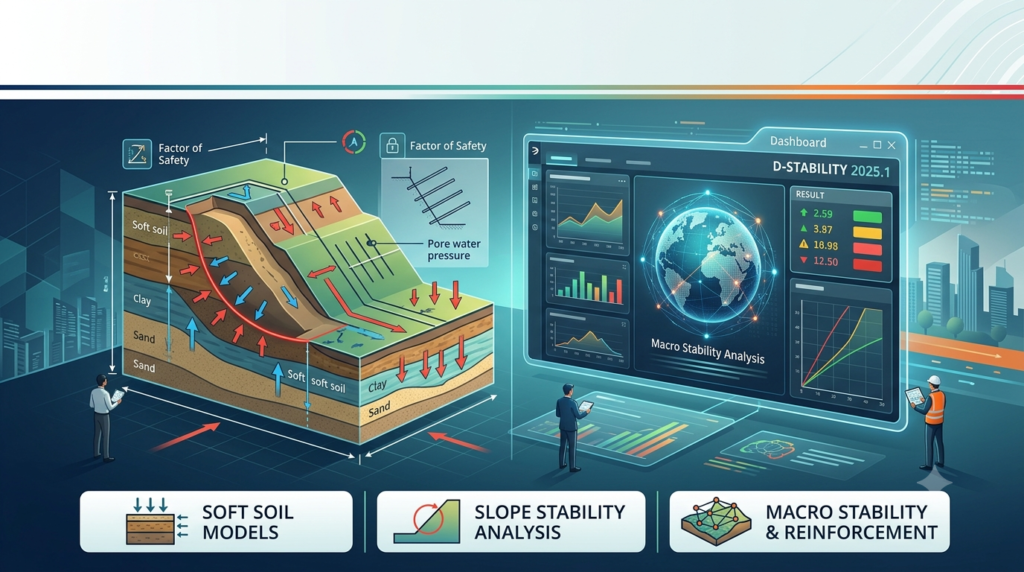
Deltares developed D-Stability to address the critical need for reliable slope stability assessment in soft soil conditions . The software forms part of the D-GEO Suite, serving the geotechnical engineering community with robust analytical tools .
Primary Purpose: The software focuses on macro stability analysis, evaluating the safety of earth structures against sliding failure through the assessment of potential slip circles .
Development Context: Deltares has been developing stability analysis tools for over 75 years. This experience is vital for the Netherlands, where 3,500 kilometres of primary dikes and over 100,000 kilometres of other embankments protect the country from flooding .
Target Users: Geotechnical engineers, dam safety inspectors, and civil engineering professionals who need accurate and efficient stability calculations for infrastructure projects . The software provides an intuitive interface that balances advanced capabilities with practical usability .
Key Features
Limit Equilibrium Methods
D-Stability incorporates three established limit equilibrium methods for comprehensive stability analysis :
-
Bishop’s Method: A widely used approach for circular slip surfaces in soil mechanics
-
Spencer’s Method: Provides more rigorous force and moment equilibrium calculations
-
Uplift-Van Method: Specialized for assessing stability under uplift conditions
Material Behavior Modeling
The software supports both drained and undrained material behavior analysis :
-
Drained Analysis: For conditions where excess pore water pressure dissipates during loading
-
Undrained Analysis: Particularly important for soft clay soils and rapid loading conditions
Shansep Analysis Support
D-Stability enables undrained Shansep analysis through staged construction functionality, tracking the yield stress field throughout the construction sequence .
Loads and Reinforcements
Engineers can model various load types and reinforcement systems :
-
Surcharge loads and structural loads
-
Geotextile reinforcements
-
Ground anchors and tiebacks
Slice Inspection
The software provides detailed examination of individual slices within the analysed slip circle, enabling thorough understanding of force distributions and failure mechanisms .
What’s New in D-Stability 2025.1
The 2025.1 version brings significant enhancements for geotechnical engineers . These improvements focus on workflow efficiency, integration capabilities, and expanded analysis options.
Enhanced Integration: The 2025.1 release delivers improved compatibility with GEOLib and GEOLib+, Deltares’ Python libraries for geotechnical and geohydrological calculations . This integration enables automated calculations and scripting capabilities for complex workflows.
Improved User Experience: The latest version continues Deltares’ commitment to an intuitive interface that allows engineers to focus on analysis rather than software navigation .
Performance Optimisation: Calculation engine improvements result in faster analysis times for complex models.
Expanded Compatibility: The software has been updated to ensure seamless operation with GEOLib for D-Stability and D-Geo Flow .
System Requirements
Before installing D-Stability 2025.1, ensure your system meets these specifications :
Hardware Requirements
| Component | Minimum Specification |
|---|---|
| Processor | 1 GHz Intel Pentium processor or similar |
| RAM | 2 GB |
| Storage | 500 MB free disk space |
| Display | 1366 x 768 resolution at 100% scale |
Important Note: If the application does not fit your screen, your display scale may be set above 100% .
Operating System Support
-
Windows 11: Fully supported
-
Windows 10: Supported
-
Older Windows versions: Not officially supported, but may work if .NET 10 is installed. The installer will request .NET installation if needed
Installation Guide
Step 1: Verify System Requirements
Check that your computer meets the minimum hardware specifications and is running a supported Windows version.
Step 2: Obtain the Software
D-Stability is available through:
-
Direct Download: From the Deltares software portal
-
Training Courses: Participants receive the software with a valid license file for course duration
Step 3: Install Dependencies
The installation process automatically checks for and installs required .NET components if missing .
Step 4: Run the Installer
-
Download the installer package from the Deltares website
-
Run the executable file with administrator privileges
-
Follow the on-screen installation wizard prompts
Step 5: License Activation
D-Stability requires a valid license file:
-
Advanced Package: Includes personal support through the Deltares online environment, available for €1425 per year
-
Basic Package: Documentation support through the Deltares website
Step 6: GEOLib Integration (Optional)
For users who want to leverage Python scripting capabilities, GEOLib and GEOLib+ packages are available through PyPI :
pip install d-geolib
pip install d-geolib-plus
How to Use D-Stability Software
Modelling the Subsurface
Begin by defining the soil stratigraphy and geometry :
-
Manually input soil layer boundaries and properties
-
Import existing D-Stability files from earlier versions
-
Import surface lines from external data sources
Defining Soil Properties
Assign appropriate parameters to each material layer:
-
Drained Parameters: Effective cohesion (c’), effective friction angle (φ’)
-
Undrained Parameters: Undrained shear strength (cu)
-
State Parameters: Yield stress field administration for staged construction
Water Pressure Modelling
Configure groundwater conditions and pore water pressure distributions :
-
Define phreatic levels for different construction stages
-
Model steady-state and transient groundwater flow
-
Account for hydrostatic pressure conditions
Applying Loads and Reinforcement
Add engineering features to the model :
-
Loads: Surcharge loads, structural loads, dynamic loads (earthquake effects)
-
Reinforcements: Geotextiles, ground anchors, soil nails
Running Stability Analysis
Execute the calculation to determine the critical slip circle :
-
Select the appropriate limit equilibrium method (Bishop, Spencer, or Uplift-Van)
-
Define analysis stages (for staged construction scenarios)
-
Run the calculation
-
Identify the critical slip circle with the minimum factor of safety
Inspecting Results
Review and verify analysis outputs :
-
Examine the representative slip circle and factor of safety
-
Inspect forces acting upon individual slices
-
Perform reliability and sensitivity analysis
-
Review calculation reports and data formats
Probabilistic Analysis
For advanced users, D-Stability supports probabilistic calculations :
-
Assess the reliability of the design
-
Determine the probability of failure
-
Account for parameter uncertainties
Best Use Cases
Flood Defence Infrastructure
D-Stability excels at assessing the stability of flood protection structures :
-
Primary Dikes: Critical flood defences protecting low-lying areas
-
River Levees: Banks protecting against river flooding
-
Regional Embankments: Secondary flood defences (20,000 km in the Netherlands)
Transportation Infrastructure
The software is ideal for linear earthworks :
-
Railway Embankments: Assessing the stability of rail track foundations
-
Highway Slopes: Evaluating cut and fill slopes alongside roads
-
Roadway Embankments: Over 100,000 km of embankments in the Netherlands
Construction Projects
D-Stability supports construction-phase analysis :
-
Staged Construction: Building up fill layers in phases
-
Temporary Slopes: Excavations and working platforms
-
Retaining Structures: Reinforced soil walls and abutments
Infrastructure Rehabilitation
Engineers can evaluate existing structures :
-
Upgrading flood defences
-
Improving embankment stability
-
Assessing the impact of climate change on stability
Advantages and Limitations
Advantages
| Benefit | Description |
|---|---|
| Specialised Functionality | Purpose-built for soft soil slope stability analysis |
| Multiple Analysis Methods | Three limit equilibrium methods for result validation |
| Staged Construction Support | Track yield stress field across construction phases |
| User-Friendly Interface | Efficient assessment and design with intuitive controls |
| GEOLib Integration | Python scripting for automated calculations |
| Comprehensive Support | Deltares training and advanced support packages available |
Limitations
| Consideration | Details |
|---|---|
| Windows-Only | The software runs exclusively on Windows operating systems |
| Domain-Specific | Designed primarily for geotechnical stability; not for other engineering disciplines |
| Licensing Cost | Advanced package requires annual subscription |
| Learning Curve | Requires understanding of geotechnical engineering principles for effective use |
| Screen Resolution Dependency | Display scaling issues may affect the interface |
Alternatives to D-Stability
Commercial Competitors
| Software | Description | Key Differences |
|---|---|---|
| EnSlope | Ensoft’s 2D slope stability solution using limit-equilibrium methods. Features graphical data input and random failure surface generation techniques. Supports reinforced-earth slopes and pile-stabilized slopes | Compatible with Windows 7 and newer; offers both circular and irregular failure surfaces; Spencer’s method support |
| SLOPE/W | Part of GeoStudio’s suite for soil and rock slope stability analysis | Comprehensive slope analysis package with extensive integration with other geotechnical packages |
| Plaxis | 2D and 3D finite element analysis for geotechnical engineering | Finite element approach rather than limit equilibrium; can model soil-structure interaction and deformation behaviour |
| Rocscience Slide | 2D slope stability analysis with limit equilibrium and finite element methods | Combined limit equilibrium and finite element slope analysis; offers comprehensive probabilistic analysis tools |
Frequently Asked Questions
What is D-Stability software used for?
D-Stability is specialised software for macro stability analysis of soft soil slopes, dikes, and embankments . It uses limit equilibrium methods to identify critical slip planes and calculate factors of safety for earth structures, helping geotechnical engineers ensure the stability of flood defences and infrastructure.
What are the system requirements for D-Stability 2025.1?
D-Stability 2025.1 requires Windows 10 or Windows 11, a 1 GHz processor, 2 GB RAM, 500 MB free disk space, and a 1366 x 768 display at 100% scale . The software automatically handles .NET installation requirements if needed.
What analysis methods does D-Stability support?
The software includes three limit equilibrium methods: Bishop’s method, Spencer’s method, and the Uplift-Van method . These approaches provide engineers with flexibility to validate stability calculations using different analytical frameworks.
Can D-Stability handle staged construction?
Yes, D-Stability supports staged construction analysis for projects built in phases. It administrates the yield stress field during construction and calculates the safety factor at each stage .
How does D-Stability handle drained and undrained conditions?
The software supports both drained and undrained material behavior analysis. For undrained analysis, D-Stability includes Shansep analysis capabilities through its staged construction functionality .
What training is available for D-Stability?
Deltares offers dedicated training courses covering software installation, modelling, analysis methods, and result interpretation. These courses include a one-month valid software license for participants and are led by experienced geotechnical designers .
Does D-Stability integrate with other software?
D-Stability integrates with GEOLib and GEOLib+, Deltares’ Python libraries for geotechnical and geohydrological calculations. This enables automated calculations and scripting through Python packages available on PyPI .
What support options are available for D-Stability?
Deltares offers Basic support (documentation and Helpdesk Water for Dutch government projects) and Advanced support (€1425 per year, including online environment support and personal telephone/email support) .
Final Thoughts
D-Stability 2025.1 represents the culmination of Deltares’ 75 years of geotechnical engineering experience. The software provides essential tools for evaluating soft soil slope stability, incorporating multiple analysis methods and practical features for infrastructure projects.
For geotechnical engineers, D-Stability offers:
-
Professional-Grade Analysis: Three limit equilibrium methods for stability calculations
-
Real-World Utility: Designed specifically for soft soil conditions common in flood defence and infrastructure projects
-
User-Friendly Interface: Accessible to engineers while maintaining sophisticated analytical capabilities
-
Integration-Ready: Python support through GEOLib for automated workflows
The 2025.1 version continues Deltares’ commitment to providing trusted software for macro stability analysis. The combination of established methods, intuitive interface, and professional support makes D-Stability a reliable choice for assessing the stability of earth structures in soft soil conditions .
For engineers requiring robust stability calculations for dikes, embankments, and other earth structures, D-Stability delivers the specialised analysis capabilities needed for safe, efficient infrastructure design and assessment.
Our Paid Service
“We do not sell or provide any software. We only offer professional support services. If any software on your system is not working properly, or you are facing installation errors, crashes, or any other technical issue — just contact us. We will help you fix the problem quickly and remotely via AnyDesk. No software will be provided from our side — only expert troubleshooting and support.”