

Download 3DCoat 2025.17 (Advanced 3D Sculpting & Texturing with New Node System) from this link…

Overview of 3DCoat 2025.17
Table of Contents
3DCoat 2025.17 is the latest iteration of Pilgway’s industry-leading 3D sculpting, texturing, and modeling software. Known for bridging the gap between voxel-based sculpting and UV-mapped polygonal modeling, this version focuses on non-destructive workflows, deeper integration with industry standards like StemCell, and significant improvements to user interface customization.
Designed for game developers, VFX artists, and 3D printing enthusiasts, 3DCoat offers a comprehensive suite of tools within a single application. From creating high-resolution organic models to preparing assets for game engines, version 2025.17 introduces a paradigm shift in how artists approach material creation and scene management.
Key Features
3DCoat is built on a foundation of powerful core technologies. Key features include:
-
Voxel Sculpting: Allows for limitless detail without worrying about topology, perfect for concept art and organic modeling.
-
UV Unwrapping: Advanced, often automated tools for creating clean, non-overlapping UV maps.
-
PBR Texturing: A full “Paint Room” that supports physically based rendering, allowing for realistic material creation.
-
Retopology Tools: Manual and automatic tools to create clean, animation-ready geometry from high-poly sculpts.
-
Node-Based Material System (New): The ability to create complex, non-destructive materials directly within the Sculpt workspace.
What’s New in 3DCoat 2025.17
This update is substantial, focusing on workflow speed, customization, and quality-of-life improvements. The headline features include:
1. The New Node Room
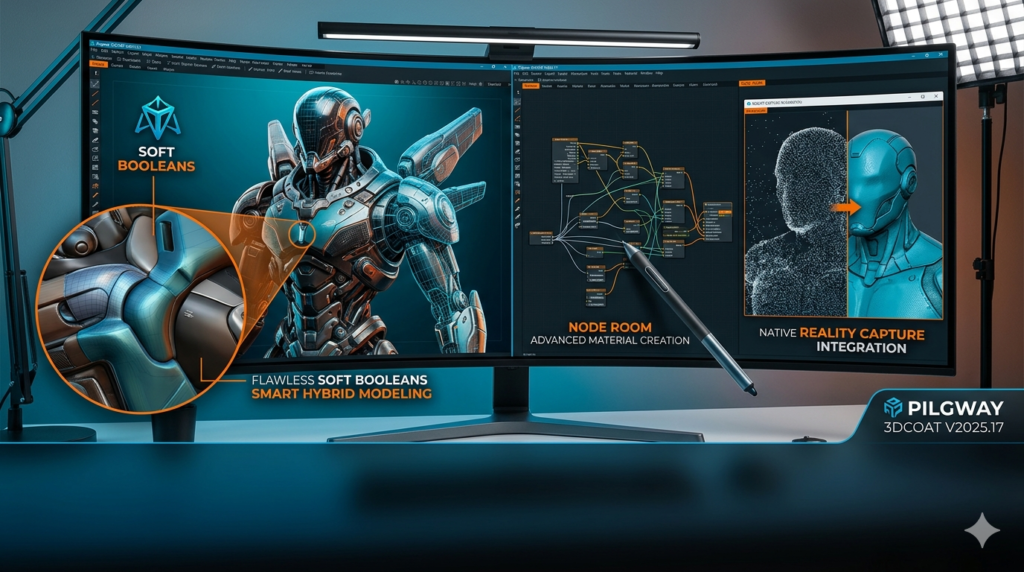
Perhaps the most significant addition is the Node Room integrated into the Sculpt workspace. Users can now create and modify non-destructive volumetric and surface materials using a node graph. This allows for complex layering and adjustments to materials without permanently altering the underlying sculpt.
2. 18 New UI Themes
Visual customization gets a major upgrade. Artists can now choose from 18 new UI themes, allowing them to tailor the workspace to their lighting environment or personal preference, reducing eye strain during long sessions.
3. Photogrammetry via RealityCapture
3DCoat now features native integration with RealityCapture. This streamlines the photogrammetry pipeline, enabling users to import real-world scanned data directly into the software to generate high-fidelity 3D models from photographs.
4. Hotkey Manager
A new centralized Hotkey Manager has been introduced. This allows for granular control over shortcuts, enabling power users to customize the software layout to match other tools like ZBrush or Blender, drastically speeding up their transition and workflow.
5. Smart Hybrid Functionality
In the Modeling workspace, the new Smart Hybrid tool creates “NURBS-like” smooth patches from low-polygon meshes. These can be saved as high-poly models, low-poly meshes, or paint meshes, offering a powerful new way to create hard-surface models with perfect curvature.
6. Surface Array and Soft Booleans
-
Surface Array: A new tool allows users to create arrays of objects on a surface or selected faces of a low-poly mesh.
-
Soft Booleans: Voxel booleans now support “soft” edges, allowing users to define a bevel radius based on the brush radius, making mechanical design and 3D printing preparation easier.
7. StemCell 3D Modeling Integration
New scripts help creators prepare models for Turbosquid’s StemCell 3D specification. A dedicated roadmap within the software assists users in preparing models for StemCell verification in a semi-automatic mode, ensuring assets meet marketplace standards for compatibility and quality.
System Requirements
To run 3DCoat 2025.17 efficiently, your system should meet the following specifications:
-
Operating System: Windows 10/11 (64-bit), macOS 10.15+, or Linux (64-bit)
-
Processor: Intel Core i5 or AMD Ryzen 5 (Intel Core i7/i9 or AMD Ryzen 7/9 recommended for complex scenes)
-
RAM: 16 GB minimum (32 GB or more recommended for high-poly sculpting and photogrammetry)
-
Graphics Card: NVIDIA GeForce GTX 1060 / AMD Radeon RX 580 or better (4GB VRAM minimum; 8GB+ VRAM recommended for 4K textures)
-
Storage: 20 GB of free space (SSD highly recommended for faster asset loading)
-
Tablet Support: Full support for Wacom, XP-Pen, and Huion drawing tablets.
Installation Guide
-
Download: Visit the official Pilgway website and navigate to the Downloads section. Select the installer for your operating system (Windows x64, macOS, or Linux).
-
Run Installer: Close any other 3D applications. Run the downloaded executable file.
-
Permissions: Allow the installer to make changes to your device if prompted.
-
Select Components: Choose whether to install the software for all users or just the current user. It is recommended to install to the default directory.
-
License Activation: After installation, launch 3DCoat. Enter your legitimate license key (purchased from the Pilgway website or an authorized reseller) to activate the software. A trial version is also available for testing.
How to Use the Software
While 3DCoat is deep, the workflow generally follows a structured pipeline:
-
Starting a Project: Open the Sculpt Room. You can start with a sphere (voxel) or import a base mesh.
-
Sculpting: Use the brushes to add or subtract volume. Utilize Voxel Mode for organic forms and Surface Mode for fine detail and hard-surface work.
-
Modeling (Hard Surface): Switch to the Modeling Room. Use the new Smart Hybrid or Surface Array tools to create mechanical parts, patterns, or NURBS-like smooth surfaces.
-
Retopology: Move to the Retopo Room to create a clean, low-poly version of your high-poly sculpt. This is essential for game engines.
-
UV Mapping: Use the UV Room to unwrap your low-poly model automatically or manually.
-
Texturing: Jump to the Paint Room. Here, you can paint color, roughness, metalness, and normal maps directly onto the 3D model. Utilize the new Node Room to create complex, layered smart materials.
-
Export: Use the Export dialog to save your final model (FBX, OBJ, etc.) and textures for use in Unreal Engine, Unity, or Blender.
Best Use Cases
-
Game Asset Creation: From high-poly sculpts to low-poly game-ready models with baked maps, 3DCoat handles the entire pipeline.
-
3D Printing: The new Volumetric Boolean operations with extra gap are crucial for creating interlocking parts with precise tolerances for 3D printing.
-
Photogrammetry Cleanup: Use the RealityCapture integration to process scans and then utilize the sculpting tools to clean up noise and fill holes in the mesh.
-
Concept Art: The voxel sculpting environment allows for rapid iteration of forms without worrying about technical constraints, enabling artists to ideate quickly.
-
Scene Assembly & Visualization: The new Transforms panel (Windows->Panels->Transforms) allows users to save scene state presets (like keyframes), making it easy to manage complex assemblies or create turntable renders for portfolios.
Advantages and Limitations
Advantages
-
Comprehensive Toolset: Combines sculpting, retopology, UV mapping, and texturing in one package.
-
Non-Destructive Workflow: The introduction of the Node Room and Smart Hybrid tools allows for high flexibility and iteration.
-
StemCell Readiness: Direct support for Turbosquid’s premium specification helps creators monetize their assets.
-
Customization: The new Hotkey Manager and 18 UI themes allow users to create a personalized workspace.
-
Performance: Efficient voxel and surface engines allow for handling of multi-million poly models.
Limitations
-
Learning Curve: While powerful, the sheer number of features and unique terminology can be daunting for beginners.
-
UI Complexity: Despite new themes, the layout of panels and rooms can feel cluttered compared to more minimalistic competitors.
-
Smaller Community: While growing, the community and number of third-party tutorials are smaller than for Blender or ZBrush.
Alternatives to 3DCoat
Depending on your budget and specific needs, here are viable alternatives:
-
ZBrush: The industry standard for high-end sculpting. It excels in organic detail but lacks the integrated UV and texturing pipeline found in 3DCoat. (Subscription-based)
-
Blender: A powerful, free, open-source alternative. It offers sculpting, modeling, and texturing tools (via the Shader Editor), though its sculpting brushes are not as refined as 3DCoat’s voxel system.
-
Adobe Substance 3D Painter: The industry leader for texturing. If you need a dedicated tool for PBR texturing but already have a separate sculpting tool, this is the best choice.
-
Mudbox: Autodesk’s sculpting tool. It is simpler and more artist-friendly than ZBrush but has seen fewer updates in recent years.
Frequently Asked Questions
1. What is the difference between Voxel and Surface mode in 3DCoat?
Voxel mode is resolution-independent and best for blocking out primary shapes and merging objects without worrying about topology. Surface mode works on a polygonal mesh, allowing for fine details, hard edges, and better performance at very high resolutions once the primary shape is established.
2. Does 3DCoat 2025.17 support Apple Silicon (M1/M2/M3) Macs?
Yes, the latest versions of 3DCoat include native support for Apple Silicon, ensuring optimized performance on M1, M2, and M3 chip Macs.
3. How do I use the new RealityCapture integration?
Within 3DCoat, navigate to the import options. If RealityCapture is installed on your system, 3DCoat can communicate with it to process images and generate a mesh directly inside the Sculpt room.
4. Can I use 3DCoat for 3D printing?
Absolutely. 3DCoat is excellent for 3D printing. The new Volumetric Boolean operations with extra gap feature is specifically designed to create parts with precise tolerance, and the Transforms panel helps with scene assembly and ensuring models are watertight.
5. Is a drawing tablet required to use 3DCoat effectively?
While you can navigate and model with a mouse, a drawing tablet with pressure sensitivity (like a Wacom or Huion) is highly recommended for sculpting, as it provides natural control over brush size, strength, and opacity.
6. How does the Node Room differ from the Paint Room?
The Paint Room is for applying textures to the surface of a model. The new Node Room allows you to build the material definition itself—how that texture looks, reacts to light, and layers with other materials—in a non-destructive, procedural way.
Final Thoughts
3DCoat 2025.17 represents a significant step forward for Pilgway. By integrating a node-based material system, embracing industry standards like StemCell and RealityCapture, and focusing on customization with the Hotkey Manager and new UI themes, the software demonstrates a commitment to staying relevant for modern 3D artists.
Whether you are a game developer looking for a single app to handle your entire asset pipeline, a 3D printing hobbyist needing precise boolean tools, or a concept artist seeking a fluid sculpting environment, 3DCoat offers a powerful and versatile solution. The addition of non-destructive workflows in this latest version ensures that artists can iterate faster and with more confidence than ever before.
Premium Software Support Service
If you need professional help with software installation, setup, or technical configuration, our team is available to assist you.
Contact & Support
For quick assistance and latest updates, connect with us using the links below:
🔹 Direct Telegram Support
https://t.me/PlayoutKing
🔹 Official Telegram Updates Group
https://t.me/yourgroup
Service Policy
- Remote testing available through AnyDesk before confirmation.
• Verify the setup and performance before completing the order.
• Support available for single or multiple systems.
• Step-by-step guidance to ensure smooth installation and working environment.
Our goal is to provide reliable technical assistance so your software runs smoothly without interruptions.