

Download the AVEVA Process Simulation 2026 (Comprehensive Guide to Chemical Process Modeling)from this link…
Overview of AVEVA Process Simulation
Table of Contents
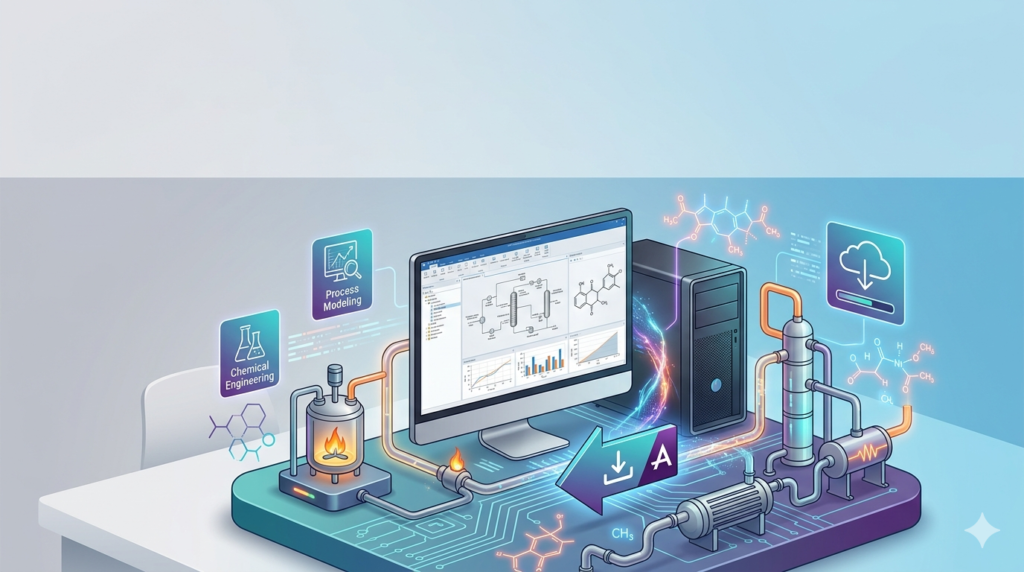
AVEVA Process Simulation is a flagship chemical engineering software platform designed for process design, operational optimization, debottlenecking, and safety analysis. Unlike legacy tools, it unifies both steady-state and dynamic modeling within a single environment.
In steady-state mode, engineers analyze design conditions, size equipment, and evaluate process alternatives. In dynamic mode, the platform supports transient studies such as startup/shutdown procedures, control loop tuning, pressure surge analysis, and safety validation scenarios.
The software includes extensive thermodynamic property packages, enabling accurate modeling of hydrocarbons, multiphase systems, electrolytes, and non-ideal mixtures. From refining and gas processing to pharmaceutical manufacturing and water treatment, AVEVA adapts to diverse industrial sectors. Engineers can model reaction kinetics, vapor-liquid equilibrium (VLE), distillation tray efficiency, column hydraulics, and advanced control strategies without switching tools.
Because AVEVA integrates natively with other engineering platforms like AVEVA Unified Engineering and AVEVA Engineering, it supports a complete digital engineering workflow—from conceptual design through commissioning and operational optimization.
Who Uses AVEVA Process Simulation?
This software is widely adopted by:
-
Process & Chemical Engineers – For flowsheet development and mass/energy balance calculations.
-
Plant Designers & EPC Contractors – To validate process flow diagrams (PFDs) and P&IDs.
-
Operational Excellence Teams – For troubleshooting bottlenecks and improving energy efficiency.
-
Oil & Gas, LNG, and Refinery Operators – For feasibility studies and front-end engineering design (FEED).
-
Academic Institutions – For advanced chemical engineering coursework in process simulation.
Teams involved in brownfield plant revamps frequently prefer dynamic simulation features to validate control system changes before real-world implementation—reducing operational risk and improving safety compliance. In industries where downtime costs thousands of dollars per hour, simulation accuracy becomes a strategic asset rather than a technical luxury.
Key Features & Technical Capabilities
AVEVA Process Simulation offers an extensive unit operation library and thermodynamic engine.
Unit Operation Library
-
Distillation – Multi-stage trays, packed columns, absorption towers, stripping units, and reactive distillation.
-
Reactor Models – Plug flow reactors (PFR), continuous stirred tank reactors (CSTR), equilibrium reactors, and custom kinetic reactions.
-
Heat Exchangers – Shell-and-tube, plate, air-cooled exchangers, and energy integration analysis.
-
Fluid Handling – Multiphase flow, phase envelope calculations, flash drums, compressors with performance curves, pump efficiency modeling, and pressure relief scenarios.
Thermodynamics & Property Packages
The thermodynamics engine supports:
-
Cubic equations of state: Peng-Robinson, Soave-Redlich-Kwong (SRK).
-
Activity coefficient models for non-ideal systems (e.g., NRTL, UNIQUAC).
-
Accurate vapor-liquid-liquid equilibrium (VLLE) calculations for hydrocarbons, specialty chemicals, and fine chemical manufacturing.
Dynamic Simulation & Digital Twin Capabilities
-
PID loop simulation, valve sizing, surge analysis, and startup sequence validation.
-
Integration with plant data historians to develop digital twin environments for performance monitoring and predictive maintenance.
What’s New in AVEVA Process Simulation 2026
The 2026 release introduces several enhancements for engineering productivity:
-
Improved Solver Performance – Faster convergence for large-scale, non-linear dynamic models.
-
Enhanced Electrolyte Chemistry – Expanded databases for mining and hydrometallurgy applications.
-
Cloud-ready Licensing – More flexible subscription and network license management.
-
Direct P&ID Integration – Bi-directional synchronization with AVEVA Diagrams.
-
User-Defined Kinetics – Simplified interface for custom reaction rate expressions.
System Requirements for AVEVA Process Simulation 2026
Before installation, ensure your system meets these recommended specifications:
| Component | Minimum Requirement | Recommended |
|---|---|---|
| Operating System | Windows 10 Pro (64-bit) | Windows 11 Pro / Windows Server 2022 |
| Processor | Intel Core i5 (4 cores) | Intel Xeon or AMD Ryzen 7 (8+ cores) |
| RAM | 8 GB | 16 GB – 32 GB (for large flowsheets) |
| Disk Space | 20 GB SSD | 30 GB NVMe SSD |
| Graphics | DirectX 11 compatible | Dedicated GPU with 2GB VRAM (for complex 3D visualization) |
| Network | Stable internet for license validation | Low-latency connection for network licensing |
Installation Guide for AVEVA Process Simulation
Follow these steps for a standard installation:
-
Download the official installer from the AVEVA customer portal or authorized partner (e.g., TeamArmaan).
-
Run the executable file as an administrator.
-
Select modules – Choose steady-state only or combined steady-state + dynamic simulation.
-
Confirm installation directory – Default is
C:\Program Files\AVEVA\Process Simulation 2026. -
Prerequisite validation – The installer checks for Microsoft .NET Framework, Visual C++ Redistributables, and database components.
-
Complete installation – Restart if prompted.
-
Install latest service pack – Always apply the most recent patch for bug fixes and performance enhancements.
For enterprise deployments, IT administrators can use centralized deployment tools (e.g., SCCM) to ensure version consistency across engineering teams.
How to License & Activate the Software
License activation depends on your agreement type: standalone (node-locked), network floating, or enterprise subscription.
Activation Steps
-
Open the AVEVA License Manager from the Start menu.
-
Choose activation method:
-
Online – Enter your license key or login to your AVEVA account.
-
Offline – Generate a machine fingerprint and obtain a response file from AVEVA support.
-
-
For network licenses – Point the client to the license server hostname and port (e.g.,
27000@licserver01). -
Verify activation status under Help > License Information.
How to Use AVEVA Process Simulation – Basic Workflow
Step 1 – Build the Flowsheet
Drag and drop unit operations (reactor, column, heat exchanger) from the palette onto the workspace. Connect streams to define material flow.
Step 2 – Define Components & Properties
Select chemical components from the databank (e.g., methane, n-butane, water). Choose a thermodynamic method (e.g., Peng-Robinson for hydrocarbons).
Step 3 – Specify Input Conditions
Enter feed stream temperature, pressure, composition, and flow rate. Provide equipment parameters (e.g., number of trays, reflux ratio).
Step 4 – Run Simulation
Click Solve or Run. The solver calculates mass/energy balances and phase behavior.
Step 5 – Analyze Results
View stream tables, phase envelopes, column profiles, and converge diagnostics. Use sensitivity analysis tools to study the impact of key variables.
Step 6 – Dynamic Mode (Optional)
Switch to dynamic mode, add controllers (PID), and simulate startup or load changes over time.
Best Use Cases & Real-World Applications
| Industry | Application |
|---|---|
| Refining | Atmospheric and vacuum distillation units, FCCU, hydrocracker modeling. |
| Petrochemicals | Ethylene crackers, polymerization reactors (CSTR, PFR). |
| Gas Processing | Amine sweetening, dehydration (glycol), cryogenic separation (LNG). |
| Pharmaceuticals | Batch reactor modeling, solvent recovery, API purification. |
| Water Treatment | Membrane performance (reverse osmosis), chemical dosing optimization. |
| Mining & Metallurgy | Leaching circuits, solvent extraction, electrowinning. |
Engineers use scenario analysis to simulate feed composition changes, ambient temperature variations, and production capacity expansion. This predictive capability supports long-term strategic planning and risk reduction.
Advantages & Limitations
Advantages (Strengths)
-
Unified environment – No data transfer between steady-state and dynamic tools.
-
AVEVA ecosystem integration – Seamless handoff to 3D plant design (AVEVA E3D) and asset information management.
-
High-performance solver – Handles large-scale flowsheets (2000+ streams).
-
Digital twin ready – Connects to PI historians for real-time operational data.
Limitations (Considerations)
-
Steep learning curve – Requires chemical engineering fundamentals.
-
Cost – Higher initial investment compared to some academic-focused tools.
-
Third-party export limits – Fewer direct interfaces to niche software (e.g., specialized hydraulic networks) compared to some competitors.
Alternatives to AVEVA Process Simulation
| Software | Best For | Key Difference |
|---|---|---|
| Aspen Plus | Refining & petrochemicals with electrolyte systems | Market leader with vast physical property database. |
| HYSYS | Upstream & gas processing | Stronger for oil/gas separation and LNG. |
| ChemCAD | Specialty chemicals & batch processes | Lower cost, easier for smaller organizations. |
| DWSIM (Open Source) | Budget-constrained academic or startup use | Free but less support and fewer unit operations. |
When to choose AVEVA: If your organization already uses AVEVA’s engineering ecosystem (E3D, Unified Engineering) or requires tightly integrated digital twin capabilities.
Frequently Asked Questions (FAQ)
1. Is AVEVA Process Simulation suitable for beginners?
Yes, but it assumes fundamental knowledge of chemical engineering (mass/energy balances, thermodynamics). AVEVA provides online training modules and a user guide.
2. Can I import an Aspen Plus or HYSYS file into AVEVA Process Simulation?
AVEVA supports import of CAPE-OPEN compliant files. Direct .apw or .hsc import requires third-party conversion tools or manual rebuilding.
3. Does AVEVA Process Simulation run on macOS?
Not natively. You can run it via Parallels Desktop or VMware Fusion with a licensed Windows virtual machine.
4. What is the difference between steady-state and dynamic simulation?
Steady-state assumes constant conditions over time (design basis). Dynamic models time-dependent behavior (e.g., control response, startup transients).
5. How much does AVEVA Process Simulation cost?
Pricing is not publicly listed. Contact AVEVA sales or an authorized distributor for a quote based on modules (steady-state only vs. combined) and license type (term vs. perpetual).
6. Can I use AVEVA Process Simulation for academic research?
Yes. AVEVA offers discounted licenses for qualified universities and research institutions through its academic program.
7. Does the software support electrolyte and non-ideal systems?
Yes. Activity coefficient models (NRTL, UNIQUAC) and the Electrolyte NRTL property package handle saline solutions, acids, and bases.
8. Is an internet connection required to run the software?
Only for license validation (online activation) and updates. After activation, you can work offline for extended periods with a standalone license.
Final Thoughts
Despite rapid digitalization, the fundamentals of chemical engineering remain rooted in thermodynamics, kinetics, and fluid mechanics. AVEVA Process Simulation 2026 bridges conceptual design, detailed engineering, and operational excellence within a single, integrated platform.
For organizations aiming to reduce risk, improve profitability, and embrace digital transformation, process simulation is a strategic foundation—not a supplementary tool. Engineers who master advanced modeling techniques, sensitivity analysis, and dynamic studies within this platform gain a competitive edge in refinery, LNG, chemical manufacturing, and energy transition projects.
The true value lies not only in accurate numbers but in the confidence those numbers provide before real-world implementation. Whether you are designing a new hydrogen plant, revamping a crude unit, or building a digital twin for predictive maintenance, AVEVA Process Simulation delivers engineering-grade rigor with modern usability.
Premium Software Support Service
If you need professional help with software installation, setup, or technical configuration, our team is available to assist you.
Contact & Support
For quick assistance and latest updates, connect with us using the links below:
🔹 Direct Telegram Support
https://t.me/PlayoutKing
🔹 Official Telegram Updates Group
https://t.me/yourgroup
Service Policy
- Remote testing available through AnyDesk before confirmation.
• Verify the setup and performance before completing the order.
• Support available for single or multiple systems.
• Step-by-step guidance to ensure smooth installation and working environment.
Our goal is to provide reliable technical assistance so your software runs smoothly without interruptions.